


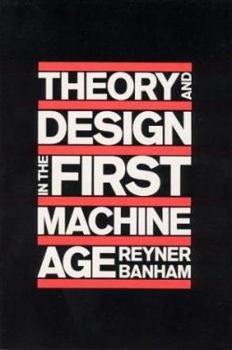
Theory and Design in the First Machine Age


Select Format
Select Condition 
Book Overview
First published in 1960, Theory and Design in the First Machine Age has become required reading in numerous courses on the history of modern architecture and is widely regarded as one of the definitive books on the modern movement. It has influenced a generation of students and critics interested in the formation of attitudes, themes, and forms which were characteristic of artists and architects working primarily in Europe between 1900 and 1930 under the compulsion of new technological developments in the first machine age.
Format:Paperback
Language:English
ISBN:0262520583
ISBN13:9780262520584
Release Date:July 1980
Publisher:Mit Press
Length:338 Pages
Weight:0.97 lbs.
Dimensions:0.8" x 5.5" x 8.2"
Age Range:18 years and up
Grade Range:Postsecondary and higher
Customer Reviews
1 rating
Insightful and well-presented study of Modern Architecture
Published by Thriftbooks.com User , 23 years ago
This book has held up well over time, as Banham explores Modern Architecture with a critical eye. First published in 1960, Theory and Design has had numerous editions but the themes remain the same. Banham looks at the major figures in European Modern Architecture through a series of penetrating sections. He begins with the "Predisposing Causes," the academic and constructive traditions of the later 19th and early 20th century. Of particular note is the relation between the English Arts and Crafts Movement and the Deutscher Werkbund through Hermann Muthesius. He follows with a section on the "Italian Futurists," whose work was widely misunderstood at the time and now widely emulated, as many of the their principles of design have been absorbed by the Deconstructivists. Next is a section on Holland and "The Legacy of Berlage and De Stijl." This is a particularly interesting chapter as he notes the influences of Frank Lloyd Wright and Cubism on this Dutch abstract movement. He also describes how De Stijl went international, influencing many other movements in Europe. The fourth section describes "The World of Art and Le Corbusier" in Paris. Here he gets into his fullest exploration of the role Cubism had in shaping architecture. Cubism had had an influence on Futurism and De Stijl, but it was the analytical branch of Cubism, led by the Duchamp brother, that would have the most impact as Le Corbusier absorbed many of these ideas into his work, evolving Cubo-Futurism into what he and Ozenfant called "Purism." The last section charts the course of the Bauhaus in "The Victory of the New Style." This is where all the separate strains came together in an international school which would have a profound influence on the shape of architecture in the 20th century.It is a tremendously insightful and well-presented study, which is a must for anyone hoping to gain a better understanding of the ideas which underlie the various strains of Modern Architecture. The focus is on Europe before WWII, with only mention of the influence American architects like Frank Lloyd Wright had on European architecture.
Copyright © 2026 Thriftbooks.com Terms of Use
| Privacy Policy | Do Not
Sell/Share My Personal Information | Cookie Policy | Cookie Preferences | Accessibility Statement
ThriftBooks® and the ThriftBooks® logo are registered trademarks of Thrift Books Global, LLC
ThriftBooks® and the ThriftBooks® logo are registered trademarks of Thrift Books Global, LLC
