


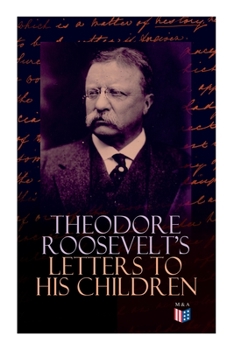
Theodore Roosevelt's Letters to His Children: Touching and Emotional Correspondence of the Former President with Alice, Theodore III, Kermit, Ethel, A


Select Format
Select Condition 
Book Overview
Most of the letters in this book were written by Theodore Roosevelt to his children during a period of more than twenty years. A few others are included which he wrote to friends or relatives about the children. He began to write to them in their early childhood, and continued to do so regularly till they reached maturity. Whenever he was separated from them, in the Spanish War, or on a hunting trip, or because they were at school, he sent them these messages of constant thought and love, for they were never for a moment out of his mind and heart. Long before they were able to read he sent them what they called "picture letters," with crude drawings of his own illustrations of the written text, drawings precisely adapted to the childish imagination and intelligence. That the little recipients cherished these delightful missives is shown by the tender care with which they preserved them from destruction. They are in good condition after many years of loving usage. A few of them are reproduced on these pages-written at different periods as each new child appeared in the household.
Format:Paperback
Language:English
ISBN:8027333849
ISBN13:9788027333844
Release Date:October 2019
Publisher:E-Artnow
Length:152 Pages
Weight:0.47 lbs.
Dimensions:0.3" x 6.0" x 9.0"
Customer Reviews
3 ratings
Excellent descriptions of early frontier life
Published by Thriftbooks.com User , 25 years ago
Before Roosevelt begins sensationalizing in the second volume, he describes the utter wilderness of the region and characterizes both the individual settlers and Indians who would play decisive roles in the settlement and migration of whites westward, and also gives sweeping portraits of the Indian nations encountered during our westward expansion. The hardships of the settlers due to the ruggedness of their new mountain home, their self-reliance, the cold winters, the need to fell forest for pasture and tillage, the daily peril of Indian attacks, and the distant relations with their origins to the east complete this wonderfully written and diversified study of early American frontier life.
A bully read, but patience helps....
Published by Thriftbooks.com User , 26 years ago
Roosevelt does quite well to capture the essence of what went on during the period when the colonists began westward. The point made by the editor that it is indeed a wonder that this work was ever created at all is well taken when one considers Roosevelt's involvement with so much else in his life while he produced what, for the time, was a very scholarly opus.One must be patient with the narrative; it tends to be choppy. One must also be patient with, or at least understanding of, TR's view of the world and especially his notion of upon whom the greater glory of the westward expansion rests.All in all, it is seemingly a must read (as is the entire series) for anyone having either an interest in the history of this time, or an interest in TR and his works.
A Great Man Writes a Great History
Published by Thriftbooks.com User , 27 years ago
Theodore's Roosevelt's "The Winning of The West" volume one is unlike most modern histories. His is a story of the founding of the American Republic West of the Original 13. This volume is of the late Colonial Period. He is unafraid to make very harsh judgements, attacking both the American Indians and the Pioneers, although it is clear who he favours. He does have many prejudices, but, to be honest, most Historians do. President Roosevelt's were just of the less respected, today at least, kind. The whole series is very much worth reading, and is a worthy investment of capital and time. Ryan M.
Copyright © 2026 Thriftbooks.com
Terms of Use | Privacy Policy | Do Not Sell/Share My Personal Information | Cookie Policy | Cookie Preferences | Accessibility Statement
ThriftBooks ® and the ThriftBooks ® logo are registered trademarks of Thrift Books Global, LLC
ThriftBooks ® and the ThriftBooks ® logo are registered trademarks of Thrift Books Global, LLC
