


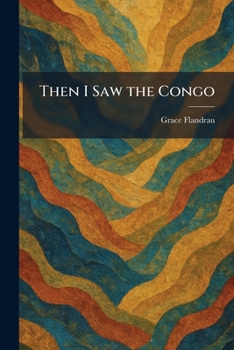
Then I Saw the Congo

Select Format
Select Condition 
Book Overview
"Then I Saw the Congo" is a compelling firsthand account of a journey across the heart of Africa during the late 1920s. Written by noted novelist and travel writer Grace Flandrau, the work chronicles an expedition that takes the author from the Atlantic coast, through the dense jungles of the Belgian Congo, and toward the Indian Ocean. Unlike many traditional colonial narratives of the era, Flandrau offers a sharp and often ironic perspective on the changing landscape of the continent, observing the complex intersection of indigenous cultures and the encroaching influence of Western civilization.
The narrative captures the raw beauty of the African wilderness while providing detailed observations of the people, customs, and daily life encountered along the way. Flandrau's prose brings to life the challenges of travel in the interior, from navigating the vast Congo River to trekking through remote regions rarely documented by Western women at the time. "Then I Saw the Congo" stands as a significant historical document of Central Africa between the World Wars, offering readers a window into a pivotal era of exploration. It remains a valuable resource for those interested in travel literature, African history, and the evolution of the Western perspective on the African continent.
This work has been selected by scholars as being culturally important, and is part of the knowledge base of civilization as we know it. This work was reproduced from the original artifact, and remains as true to the original work as possible. Therefore, you may see the original copyright references, library stamps (as most of these works have been housed in our most important libraries around the world), and other notations in the work.
This work is in the public domain in the United States of America, and possibly other nations. Within the United States, you may freely copy and distribute this work, as no entity (individual or corporate) has a copyright on the body of the work.
As a reproduction of a historical artifact, this work may contain missing or blurred pages, poor pictures, errant marks, etc. Scholars believe, and we concur, that this work is important enough to be preserved, reproduced, and made generally available to the public. We appreciate your support of the preservation process, and thank you for being an important part of keeping this knowledge alive and relevant.
Customer Reviews
ThriftBooks ® and the ThriftBooks ® logo are registered trademarks of Thrift Books Global, LLC
