


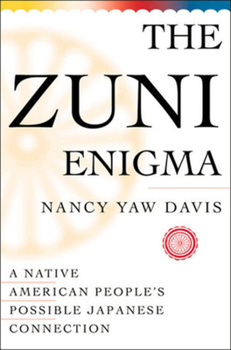
The Zuni Enigma : A Native American People's Possible Japanese Connection


Select Format
Select Condition 
Book Overview
Did a group of thirteenth-century Japanese merge with the people, language, and religion of the Zuni tribe? For many years, anthropologists have understood the Zuni in the American Southwest to occupy... This description may be from another edition of this product.
Format:Hardcover
Language:English
ISBN:0393047881
ISBN13:9780393047882
Release Date:January 2000
Publisher:W W Norton & Co Inc
Length:318 Pages
Weight:1.60 lbs.
Dimensions:12.8" x 1.3" x 6.5"
Customer Reviews
4 ratings
Interesting theory for an open mind
Published by Thriftbooks.com User , 23 years ago
I disagree with my fellow Zunis that the contents of the book couldn't have been possible or suggest discrediting it. The fact that the book is titled "Zuni Enigma" is correct in the true sense of the word enigma. It raises many more questions than can be answered and the author states this intention up front. She makes the plea that all these questions require further study. Whether you call it a theory or a hypothesis, it is to her credit that she recognized something that no one else had and now it is up to the experts in their respective fields to confirm or disprove her theory. As she mentioned, it took her over 40 years of gathering evidence and consulting before she wrote the book. I don't think anyone could accuse her of rushing to get the book out. I can see how someone can be threatened by the mere mention of a connection to another culture such as the Japanese. Maybe it is a reaction to typical anthropological ideas where a Native American culture couldn't possibly have original or distinct ideas. This may be one reason that the typical Zuni would jump to conclusions about the author's intentions. I heard the radio talk show in Albuquerque, NM when the author was interviewed along with our governor and councilman. I felt ashamed as a Zuni how close minded and rude they were to Nancy Yaw Davis. She was very cordial to them and didn't get upset despite their behavior. She kept repeating that the material needed further study. It seemed to me that the councilman only saw what he wanted to see and took several comparisons to words out of context. He seemed offended and thought that the book was about the Zuni's coming from Japan. It was a very uncharacteristically Zuni reaction. It is a part of our culture to treat everyone with respect and not to "hurt another's heart" whoever they might be. The one aspect of the language that we might never know is the actual pronunciation of "old Zuni" words. Since Zuni is not a written language, it has changed throughout the years and some of the proposed identical words might have been more so in antiquity. One observation that stood out for me was the word "hai!" when listening to one another, to signify "I hear you, I understand, go on." As anyone who might have seen the "Shogun" series on TV, that was a Japanese response with the same meaning. The word might not be used with the younger people, but I remember hearing it a lot as I was growing up. The Zuni language is like no other surrounding Pueblo language or like any other in the world. I found the following observations compelling for this reason. Basic Zuni and Japanese syntax are both subject-object-verb. Both languages primarily alter words with suffixes, not with prefixes or internally. Japanese and Zuni employ 22 phonemes, and 17 are the same. All the vowels and 12 out of 16 consonants are identical. I agree with the author about the uniqueness of our Zuni people and the rich heritage we still possess. I would recommend the book mo
Fascinating new idea, amazing connections
Published by Thriftbooks.com User , 25 years ago
Anthropologist Nancy Yaw Davis was first struck by similarities between a chart of yin-yang cosmology and the Zuni religious system she had already mapped as a grad student in 1960. Gathering suggestive evidence from a variety of disciplines, from ceramics and linguistics to medical/genetic, she has taken 40 years to bring it all together in this book, so one could hardly accuse her of rushing to publish!Her thesis is that Japanese immigrants -- perhaps Buddhist priests, perhaps peasants fleeing persecution or seeking a better life -- crossed the Pacific and made their way to the Southwest interior by the late 13th century, to merge with the locals (Anasazi?) and give rise to the Zuni. Her evidence is all circumstantial, but quite suggestive, perhaps even persuasive.Other reviewers have mentioned the Japanese chrysanthemum and Zuni sacred rosette, artwork, and kidney disease. Zuni creation myths, with their stories of ancestors coming from the west to escape earthquakes and find the middle of the earth, are tantalizing. There are considerable similarities between Japanese syntax and words, and Zuni, for which linguists have been able to find no other relations. The Type B blood allele tends to be absent in all other Native American tribes, high in Asians (20-40 percent), low in Caucasians (0-15 percent) -- but between 10-32 percent of Japanese carry it, and about 10 percent of Zuni.There are many other disciplines into which Yaw Davis dips and finds commonalities between Japanese and Zuni: folk practices for training children, archeological deposits off the coast of California containing ancient iron spikes and huge, heavy, Chinese-style stone "doughnut" anchors, Asian coins woven into Tlingit armor. I was particularly intrigued by the fact that lead glazed pottery, found nowhere else in the Southwest but common in Asia, turns up among the Zuni in the late 13th century, but deteriorates and disappears soon after, which implies a sudden introduction that didn't last.The book is easily readable -- sometimes TOO casually written (what does it mean to say that, after inventing language, humans "literally took off"?) -- and has plenty of maps and photos. Yaw Davis could have organized her case better, and restated her thesis and its strongest evidence at the end instead of cutting the book short rather abruptly.But the case is compelling, and one looks forward to the specialists in various other fields putting her theory to the test.
The Open mind Asks The Best Questions.
Published by Thriftbooks.com User , 25 years ago
Not unlike Joseph Campbell's Hero with a Thousand Faces, Nancy Yaw Davis, after decades of research, has been on a five-year journey to write this book and has returned with "my theory of a thousand themes". Did a group of thirteenth-century Japanese pilgrims journey to the American Southwest, there to merge with the people, language, and religion of the Zuni tribe? The beauty of this book is that she is a very articulate guide as she takes you back through time in order to understand the present. Why does the Japanese imperial emblem (the Chrysanthemum) look so much like the Zuni sacred rosette? Why are the nearby Hopi Indians the only ones that do sand paintings and why are they similar to Tibetan Buddhist mandalas? Why do the earliest pottery fragments in the New World occur near the tip of South America and not near the Bering Strait? Why do the Zunis and the Japanese share a rare kidney disease? Why did the Zuni veteran of World War II and a prisoner of the Japanese say: "I always wondered why I spoke Japanese so easily"? With 227 pages of easily read text, 98 figures, maps and tables, 49 pages of endnotes and 31 pages of bibliography, she offers the evidence and asks the scientific community to open their minds and begin to think differently. How many Ph.D. candidates will do their thesis on the evidence she offers and the many questions she asks? A good read for everyone and great conversation enhancer.
Really fascinating read
Published by Thriftbooks.com User , 25 years ago
What a great book. Facts are presented very clearly and in detail. If you're interested in either Japanese or Native American history this is worth the price of the hardcover. Is the author's thesis correct? Well, that's hard to say for sure but she poses very credible arguments and definately leaves the reader with a lot of fascinating possibilities on the origin of Zuni culture. The book is not necessarily light reading but it is a fairly easy read just because the subject matter is so well-presented. You can tell this was a real labor of love for the author. A must for any anthropology student!
Copyright © 2026 Thriftbooks.com Terms of Use
| Privacy Policy | Do Not
Sell/Share My Personal Information | Cookie Policy | Cookie Preferences | Accessibility Statement
ThriftBooks® and the ThriftBooks® logo are registered trademarks of Thrift Books Global, LLC
ThriftBooks® and the ThriftBooks® logo are registered trademarks of Thrift Books Global, LLC
