


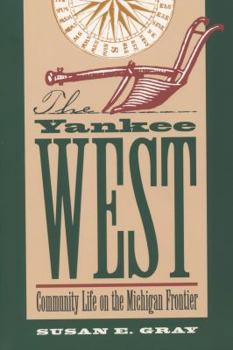
Yankee West
No Customer Reviews

Select Format
Select Condition 
Book Overview
Susan Gray explores community formation among New England migrants to the Upper Midwest in the generation before the Civil War. Focusing on Kalamazoo County in southwestern Michigan, she examines how 'Yankees' moving west reconstructed familiar communal institutions on the frontier while confronting forces of profound socioeconomic change, particularly the rise of the market economy and the commercialization of agriculture. Gray argues that Yankee culture was a type of ethnic identity that was transplanted to the Midwest and reshaped there into a new regional identity. In chapters on settlement patterns, economic exchange, the family, religion, and politics, Gray traces the culture that the migrants established through their institutions as a defense against the uncertainty of the frontier. She demonstrates that although settlers sought rapid economic development, they remained wary of the threat that the resulting spirit of competition posed to their communal ideals. As isolated settlements developed into flourishing communities linked to eastern markets, however, Yankee culture was transformed. What was once a communal culture became a class culture, appropriated by a newly formed rural bourgeoisie to explain their success as the triumphant emergence of the Midwest and to identify their region as true America.
Format:Paperback
Language:English
ISBN:0807846104
ISBN13:9780807846100
Release Date:November 1996
Publisher:University of North Carolina Press
Length:242 Pages
Weight:0.90 lbs.
Dimensions:0.7" x 6.1" x 9.2"
Customer Reviews
0 rating
Copyright © 2026 Thriftbooks.com
Terms of Use | Privacy Policy | Do Not Sell/Share My Personal Information | Cookie Notice | Cookie Preferences | Accessibility Statement
ThriftBooks ® and the ThriftBooks ® logo are registered trademarks of Thrift Books Global, LLC
ThriftBooks ® and the ThriftBooks ® logo are registered trademarks of Thrift Books Global, LLC
