


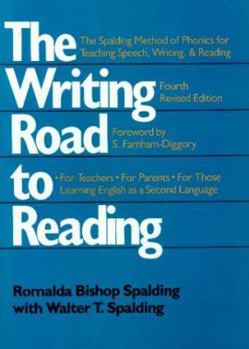
The Writing Road to Reading : The Spalding Method of Phonics for Teaching Speech@@ Writing and Reading


Select Format
Select Condition 
Book Overview
Revised This description may be from another edition of this product.
Format:Hardcover
Language:English
ISBN:0688100074
ISBN13:9780688100070
Release Date:January 1
Publisher:HarperCollins Publishers
Length:288 Pages
Weight:1.57 lbs.
Dimensions:8.1" x 1.1" x 5.1"
Customer Reviews
4 ratings
My kids did great with Spalding Phonics
Published by Thriftbooks.com User , 20 years ago
Kids can pick up a lot more than you realize, Penelope. I learned to read using this same method, when I was a kid in the 1970's, and to this day, I never mis-spell a word, and I still remember all the markings, rule numbers, and phonics sound numbers. I have taught my own kids to read with this method, and in kinder and 1st grade, they could spell better than most 5th graders. They automatically remember to underline phonograms and number them according to which sound they make. I totally disagree with Penelope who said Spalding is too complex for kids to learn - kids are like sponges that soak up everything you teach them. When they learn the rule numbers and markings, it becomes second nature to spell, write, and pronounce things correctly when reading. For example, you underline "th" in a word, because you don't want the child to say "t" and then "h". By underlining it, they learn to recognize "th" as a separate sound. If it says "thin" then that's the first sound of "th", but if it says "this" then you put a #2 above the underlined "th" to show that it's the 2nd sound of "th". It's not hard - my kids picked it up right away, and they even recognize and point out phonics sounds and rules while reading. There are also rules that they learn to recognize, such as rule #2, that says the letter "c" always says it's 2nd sound (s) if it's followed by an e,i,or y. My kindergartner can understand that and recognize it in words, so why shouldn't an adult understand it? If an adult doesn't understand it, it's because she hasn't taken the time to study the method before teaching it. Yes, you do need to spend time reading the method first, but it's worth it, when you see your kids reading and spelling better than kids older than themselves.
teacher-tested! Excellent approach
Published by Thriftbooks.com User , 22 years ago
I am a first grade teacher in a public school and am currently taking a 45-hour class on this book! I can't imagine just picking the book up, reading it, and being able to implement it. I started this method with my first graders after the first two classes I took. I, too, thought the "marking system" to be ridiculous AT FIRST. But, I am totally amazed by how quickly a 6-year old can pick it up. What might seem totally confusing to adults is actually fairly simple to a child. The marking system enables the child to thoroughly analyze the words they write, and eventually they will internalize the rules of our language. In just 4 weeks, I have really seen remarkable results in my students. This is a fantastic book for any educator! If you can't take a class offered by Spalding trainers, then take your time reading and implementing it.
I love this easy effective method
Published by Thriftbooks.com User , 26 years ago
I have been home schooling for a few years now. My son has language based disabilities, so reading has been a challenge. I started using this method this past school year, and what a difference it has made. My son is becoming more confident that he can read, he using hIs "sounds" all the time now when confronted with new words. At the end of the school year, I was cleaning out our "classroom", and he asked me to leave his sounds up on the wall, so that in case he wanted to read during the summer, he could go to the classroom and look at the sounds if he needed help. Just the fact that he believes he can read is wonderful, let alone that he wants to use his school "tools" during the summer. It makes me smile. Spaulding is wonderful and can really help speed along most any beginning reader.
Outstanding results, inexpensively, every time.
Published by Thriftbooks.com User , 27 years ago
I introduced the Spalding method to three small rural communities in northern New Hampshire when I was their superintendent of schools. The results were dramatic and immediate. It cost us approximately $4 per pupil, including teacher training, to implement the program, and within one year our standardized test scores (ITBS and SRA) went from the 40th to the 80th percentiles--AND STAYED THERE--on all reading and language subscores. I had kindergarten children reading newspapers and magazines and pronouncing every word correctly (comprehension is another matter, as that capability is a function of experience and maturation). First graders are writing in cursive by November of the school year. The usual blocks to fluency, ease, decoding, and expression are removed when children are taught this method. Concommitantly with the introduction of Spalding, although I was never able to prove a direct correlation (the overall number of children was too small), our referrals to special education for learning disabilities dropped by ten percent a year for the first three years, and then stablized--providing a dramatic cost savings to the taxpayers, but more important, giving the gift of literacy to nearly every child. There are extensive studies in linguistics and the psychoneurology of language acquisition to substantiate the validity of teaching "phonics first, phonics fast." And of course the proof is always in the puddin'. If you value literacy for your children, get the Spalding method implemented in your school ASAP. (Also very effective for home schoolers.)
Copyright © 2026 Thriftbooks.com
Terms of Use | Privacy Policy | Do Not Sell/Share My Personal Information | Cookie Policy | Cookie Preferences | Accessibility Statement
ThriftBooks ® and the ThriftBooks ® logo are registered trademarks of Thrift Books Global, LLC
ThriftBooks ® and the ThriftBooks ® logo are registered trademarks of Thrift Books Global, LLC
