


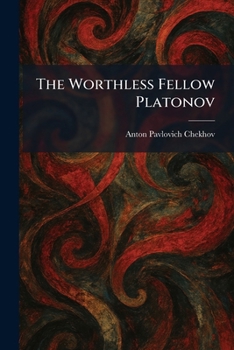
The Worthless Fellow Platonov

"The Worthless Fellow Platonov" is a seminal dramatic work by the renowned Russian master Anton Chekhov. Written during his early years, this play offers a compelling glimpse into the development of Chekhov's unique literary voice and his mastery of character studies. The narrative centers on Mikhail Platonov, a disillusioned and charismatic provincial schoolteacher whose magnetic yet destructive personality entangles him in a complex web of romantic rivalries and social tensions.
Set against the backdrop of a decaying country estate, the play explores themes of moral stagnation, financial ruin, and the existential malaise of the late 19th-century Russian gentry. Through sharp dialogue and a sophisticated blend of tragicomedy, Chekhov paints a vivid portrait of a society in transition, struggling with the weight of its own inertia. As Platonov's relationships with several different women reach a breaking point, the work delves into the complexities of human desire and the often-painful consequences of a life lived without clear direction.
This early masterpiece serves as an essential precursor to Chekhov's later canonical plays, showcasing his nascent ability to capture the intricacies of the human condition with both humor and pathos. "The Worthless Fellow Platonov" remains a vital piece of world literature, offering a profound exploration of character and social critique.
This work has been selected by scholars as being culturally important, and is part of the knowledge base of civilization as we know it. This work was reproduced from the original artifact, and remains as true to the original work as possible. Therefore, you may see the original copyright references, library stamps (as most of these works have been housed in our most important libraries around the world), and other notations in the work.
This work is in the public domain in the United States of America, and possibly other nations. Within the United States, you may freely copy and distribute this work, as no entity (individual or corporate) has a copyright on the body of the work.
As a reproduction of a historical artifact, this work may contain missing or blurred pages, poor pictures, errant marks, etc. Scholars believe, and we concur, that this work is important enough to be preserved, reproduced, and made generally available to the public. We appreciate your support of the preservation process, and thank you for being an important part of keeping this knowledge alive and relevant.
Related Subjects
DramaCustomer Reviews
ThriftBooks ® and the ThriftBooks ® logo are registered trademarks of Thrift Books Global, LLC
