

Skip to content
Scan a barcode
Scan
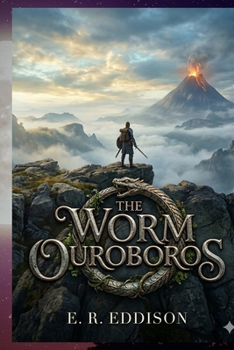
Paperback The Worm Ouroboros Book

ISBN: B0GVPSNKG3

ISBN13: 9791043139383

The Worm Ouroboros

(Book #0 in the The Zimiamvian Trilogy Series)

Select Format

Select Condition ThriftBooks Help Icon

Recommended

Format: Paperback

Condition: New

$29.83
Save $0.16!
List Price $29.99
Ships within 2-3 days
Save to List

Book Overview

The Worm Ouroboros is considered to be one of the foundational texts of the high fantasy genre, influencing later authors like J. R. R. Tolkien, C. S. Lewis, Ursula K. Leguin, and James Branch Cabell. It is most frequently compared to The Lord of the Rings in its epic scope set against a medieval, magic-laced backdrop-a world called "Middle Earth" by Eddison, thirty-two years before Tolkien's-and in its almost mythical portrayal of larger-than-life heroes and villains.The plot begins simply enough: The Lords of Demonland, a group of heroic warriors enjoying a strained peace, are called upon by an emissary of the warlock king of Witchland, Gorice XI. The emissary demands that Demonland submit to the King of Witchland-but the proud Demons refuse, setting off an epic war that spans their entire world. The heroic struggles of the Demons and their allies against the Witches reflect the circular nature of human history: the snake eating its own tail of the title.The novel is written in a purposefully archaic, almost Jacobean style. The rich, surprising vocabulary and unusual spelling are testaments to Eddison's expertise at reading and translating medieval-era texts. To this day, it remains perhaps unique in fantasy literature in the accuracy and precision of its highly affected prose style, perhaps matched only by the out-of-time strangeness of the prose in Hodgson's The Night Land. But where critics often find The Night Land's prose obtuse and difficult, they have nothing but praise for Eddison's beautiful, quotable style.Eddison had already imagined the story and its heroes as a child, and drawings he made as a youth of events in the book are preserved in the Bodleian library. While the novel is without a doubt the work of a mature and skilled writer, and while some of the events and characters are portrayed differently in the novel than they were in his youthful sketches, the names of many of the characters and places remain unchanged. Some of his contemporaries, like Tolkien, wondered about the strange naming style; others criticized it as taking away from the more serious subject matter.The Worm Ouroboros remains one of the most influential works in the high fantasy genre to this day, and traces of the foundation it laid can be still be found in genre books a century after its publication.

Customer Reviews

2 ratings

A Giant among Giants

Some books are optional. "The Worm Ouroboros", by E. R. Eddison, is not. It is more than just the birth of high fantasy writing as we know it. It is a tale that connects with imagination and wonder in a way that books today simply don't do. When you read "The Worm Ouroboros" you'll realize that modern writers produce stories, but they don't tell Stories. Since the English language fails to provide me with adequate superlatives for this review, I'll just have to present samples of Eddison's writing: "But a great wonder of this chamber, and a marvel to behold, was how the capital of every one of the four-and-twenty pillars was hewn from a single precious stone, carved by the hand of some sculptor of long ago into the living form of a monster: here was a harpy with a screaming mouth, so wonderously cut in ochre-tinted jade it was a marvel to hear no scream from her: here in wine-yellow topaz a flying fire-drake: there a cockatrice made of a single ruby: there a star sapphire the colour of moonlight, cut for a cyclops, so that the rays of the star trembled from his single eye: leviathans, all hewn from faultless gems, thrice the bulk of a big man's body, velvet-dark sapphires, crystolite, beryl, amethyst, and the yellow zircon that is like transparent gold." (7) Everyone can write description, but only Eddison could write description like this. He makes the colors shine brighter and the shapes of the "monsters" stick out in your mind. And even though you may not know what a crystolite looks like, you agree that it fits perfectly into this paragraph. Eddison realized that you can't a world that mirrors the heroic past if you get stuck in the decidedly un-heroic language of modern times. "Now had they for three days or four a devious journey through the foot-hills, and thereafter made their dwelling for forty days' space in the Zia valley, above the gorges. Here the valley widens to a flat-floored amphitheatre, and lean limestone crags tower heavenward on every side. High in the south , couched above great gray moraines, the Zia glacier, wrinkle-backed like some dragon survived out of the elder chaos, thrusts his snout into the valley. Here out of his caves of ice the young river thunders, casting up a spray where rainbows hover in bright weather. The air blows sharp from the glacier, and alpine flowers and shrubs feed on the sunlight." (153) Perhaps it's because I'm a mountain-climber myself, but I found Juss and Brandoch Daha's assault on Koshtra Pivrarcha to be the most memorable chapter in a book built out of unforgettable chapters. In real life no two mountain ranges are alike, yet most fantasy authors write only staid standard-issue descriptions when they make mountains. Eddison understood that for us to see the glaciers, feel the biting cold winds, and experience the exhilaration of reaching the summit with the heroes, he needs to give his mountains some real personality. These samples, of course, only scratch the surface of E

Beauty at the heart of the world

As a youngster I devoured fantasy greedily, any fantasy (there was not a fantasy-genre industry in those days, and fantasy was hard to come by.) Much of what I liked then I can no longer read: too much bombast and adolescent wish-fulfilment But Eddison improves with each rereading.His prose is beautiful, as everyone remarks. If you don't have the patience for sentences of more than two clauses, or if you have a prim horror of archaic language, you should skip this book. (Or maybe you should re-examine the rewards of patience: but that's another matter). But if you have the capacity to appreciate beautiful English prose, if you can read Sir Thomas Browne or the King James Bible with pleasure, then you have a treat in store. Read this book: there aren't many like it.There's a serious philosophy in this book. Eddison believes in greatness. It's no accident that his literary antecedents are in classical Greece and Iceland: Alkibiades and Grettir would have understood his devotion to the heroic, to the ferocious, doomed attempt to set one's indelible mark on the stream of time. For Eddison the reckless, whole-hearted, passionate life is the only life worth living, and the only life worth writing about.It's not a philosophy I agree with. It lives too close to fascism and machismo for me: it insists upon and glorifies a sense of Self that I think is ultimately nonsense. But it's a philosophy that produced much of the most beautiful literature of the last century: Ezra Pound and William Butler Yeats often wrote from just this standpoint. It may be wrong, but it's not childish. It situates Beauty at the heart of the world: greatness, to Eddison, is beautiful action, and all beautiful things demand worship. And reward it. "What I have promised," says Eddison's Aphrodite, "I will perform."Read this book. Read Mistress of Mistresses too. They're dazzling, magnificent books.
Copyright © 2026 Thriftbooks.com Terms of Use | Privacy Policy | Do Not Sell/Share My Personal Information | Cookie Policy | Cookie Preferences | Accessibility Statement
ThriftBooks ® and the ThriftBooks ® logo are registered trademarks of Thrift Books Global, LLC

GoDaddy Verified and Secured