


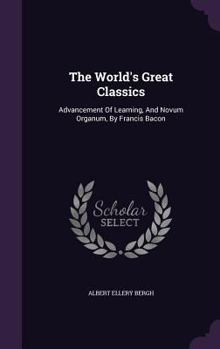
The World's Great Classics: Advancement Of Learning, And Novum Organum, By Francis Bacon
No Customer Reviews

Select Format
Select Condition 
Book Overview
This volume presents two foundational works by Francis Bacon: "Advancement of Learning" and "Novum Organum." Bacon, a pivotal figure in the scientific revolution, advocates for empirical observation... This description may be from another edition of this product.
Format:Hardcover
Language:English
ISBN:1354946758
ISBN13:9781354946756
Release Date:April 2016
Publisher:Palala Press
Length:462 Pages
Weight:1.81 lbs.
Dimensions:1.0" x 6.1" x 9.2"
Related Subjects
History Literary Literary Criticism & Collections Literature Literature & Fiction PhilosophyCustomer Reviews
0 rating
Copyright © 2026 Thriftbooks.com Terms of Use
| Privacy Policy | Do Not
Sell/Share My Personal Information | Cookie Policy | Cookie Preferences | Accessibility Statement
ThriftBooks® and the ThriftBooks® logo are registered trademarks of Thrift Books Global, LLC
ThriftBooks® and the ThriftBooks® logo are registered trademarks of Thrift Books Global, LLC
