


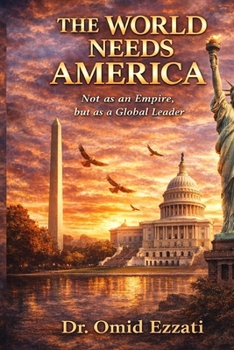
The World Needs America: Not as an Empire, but as a Global Leader

The contemporary international system is not primarily suffering from an excess of power, but from a profound absence of leadership. While global institutions continue to function formally and diplomatic language remains abundant, the capacity to deter violence, restrain authoritarian aggression, and enforce international norms has steadily eroded. This gap between legitimacy and enforcement has produced a world that is increasingly unstable, more violent, and less predictable. Since the end of the Cold War, the international order has oscillated between moments of unipolar dominance and phases of strategic hesitation. The expectation that multilateral institutions, legal norms, and collective decision-making could replace decisive leadership has repeatedly failed to materialize. Instead of preventing atrocities, prolonged deliberation and consensus-based paralysis have often allowed crises to deepen, authoritarian regimes to consolidate power, and non-state violent actors to expand their reach (Mearsheimer, 2019).
The erosion of leadership has not resulted in a more egalitarian or peaceful world. On the contrary, historical patterns suggest that power vacuums invite aggression rather than restraint. When credible deterrence disappears, the cost of violence decreases, and the incentives for repression increase. This dynamic has been visible across regions-from Eastern Europe to the Middle East and East Asia-where ambiguity, hesitation, and delayed responses have emboldened authoritarian actors (Walt, 2018). Global governance structures, particularly the United Nations, possess normative legitimacy but lack independent enforcement capabilities. In practice, these institutions depend on the willingness and capacity of major powers to translate norms into action. When leadership is absent or fragmented, international law becomes declaratory rather than operative, and moral commitments are reduced to symbolic gestures (Barnett & Duvall, 2005). The result is not neutrality, but permissiveness toward violence.
The crisis of leadership is therefore not a crisis of ideals, but a crisis of implementation. Human rights, civilian protection, and international stability do not fail because they are morally flawed, but because they are insufficiently backed by power capable of enforcement. As classical and contemporary realist scholarship has long argued, order precedes justice; without order, ethical principles remain aspirational rather than actionable (Waltz, 1979). This book begins from the premise that leadership in the international system is neither synonymous with empire nor inherently oppressive. Leadership, when exercised responsibly, functions as a stabilizing force that raises the cost of aggression and constrains the behavior of violent actors. The absence of such leadership does not liberate weaker states or vulnerable populations; it exposes them to greater danger. The global crisis of leadership is thus the defining condition of the current international order. Understanding this crisis-its origins, its consequences, and its alternatives-is a necessary first step toward any serious discussion of global stability. The chapters that follow do not seek to romanticize power, but to examine why, in a world structured by force as well as norms, the absence of leadership has proven more destructive than its imperfect presence.
Customer Reviews
ThriftBooks ® and the ThriftBooks ® logo are registered trademarks of Thrift Books Global, LLC
