


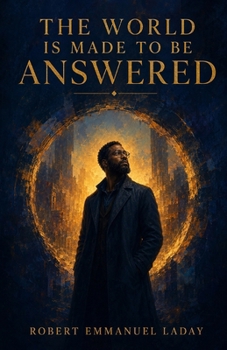
The World Is Made to Be Answered (StillPoint)

What if the deepest crisis of faith is not simply a lack of proof, but the assumption that reality can be reduced to what can be observed from the outside? The World Is Made to Be Answered begins with the modern evidence problem: miracle, resurrection, science, consciousness, and the unresolved first-person reality of being a person who knows the world from within. Robert Emmanuel LaDay starts where many people start-with the demand for proof-and then turns toward a larger question. If reality contains subjects and not only objects, inwardness and not only surfaces, then perhaps the world is not merely something we inspect. Perhaps it also addresses us. From there, the book moves into sacred time. Sabbath and Jubilee become more than religious practices. They become ways of naming limits, release, return, and the refusal to let life become permanent extraction. Time itself becomes a form of mercy: a boundary against endless production, endless possession, endless performance, and the quiet belief that everything entrusted to us must remain under our control. The argument then moves outward into institutions. Refusal can harden into structure. Mercy can also be organized into form. Families, churches, schools, economies, and governments can either keep people reachable or train them to harden. Authority can remain stewardship, or it can mutate into possession. Access can be protected, or it can be managed until the gatekeeper begins to mistake proximity to the center for ownership of it. The weak become the first witnesses to whether a system is merciful, because they are the first to feel what happens when structure forgets its limits. The question is not whether form exists, but what the form produces. Does it preserve reachability, interrupt extraction, and make return possible? Or does it harden into a machine that protects itself? At the center of the book is Christ as the self-giving Center: not another gatekeeper, but the One who gives Himself. In that light, the question of faith changes. It is no longer only, "What do you believe?" It becomes, "What kind of life does your belief make possible? What kind of calendar? What kind of authority? What kind of community? What kind of mercy?" This book does not ask the reader to abandon reason. It argues that reason does not exhaust reality. Science can describe measurable patterns, but the person doing the measuring still has to answer the fact of being here. Theology can name God, but theology also becomes dangerous when its language hardens into possession. Institutions can protect life, but they become predatory when they forget that authority is borrowed rather than owned. The World Is Made to Be Answered is theological and philosophical nonfiction about faith and reason, consciousness, Sabbath, Jubilee, formation, institutional mercy, authority, Christ, and the responsibility to answer reality from within. It is for readers who are tired of the false choice between uncritical certainty and endless deconstruction; between cold structure and shapeless compassion; between a faith that refuses questions and a skepticism that pretends it has none. It is a book about what happens after diagnosis: how mercy takes form, how authority learns restraint, how transition can happen without purge, and how a reachable people carries something forward without turning it into possession. It is also a book about answerability. What does it mean to live as though time is not ours to dominate, people are not ours to possess, truth is not ours to weaponize, and authority is not ours to turn into ownership? What changes when mercy is not treated as sentiment, but as structure? What happens when stopping, release, return, and restraint become part of the architecture of a life rather than occasional exceptions to it? The book ends where it began: not with a system that closes reality, but with a handoff. The world is not only made to be observed. It is made to be answered.
Customer Reviews
ThriftBooks ® and the ThriftBooks ® logo are registered trademarks of Thrift Books Global, LLC
