


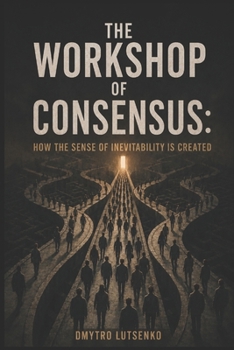
The Workshop of Consensus: How the Sense of Inevitability Is Created

Why are politicians still able to achieve their goals despite unprecedented public access to political information and widespread political fatigue? The usual answer, spin, is no longer sufficient, and may never have been: citizens today have absorbed decades of film and journalism exposing exactly how political messaging works, yet governments still convert contested choices into unquestioned facts with remarkable reliability.
The Workshop of Consensus explains how. Drawing on a catalogue of fifty-three documented political strategies and adapting process tracing to identify the key mechanisms through which politicians operate, this book examines four major cases-austerity in Britain, Finland and Sweden's rush to NATO, Germany's energy transformation, and American healthcare reform. It argues that manufactured inevitability results not from any single tactic but from five mechanisms working in sequence: narrowing alternatives, absorbing opposition, recasting choice as necessity, embedding decisions in costly-to-reverse structures, and only then narrating the outcome as though it could never have been otherwise.
What connects these mechanisms is not concealment but calibration - political actors continuously adjusting their methods against a public they know is watching and know is sceptical. Political influence has not defeated public awareness; it has learned to build that awareness into its own machinery.
Customer Reviews
ThriftBooks ® and the ThriftBooks ® logo are registered trademarks of Thrift Books Global, LLC
