


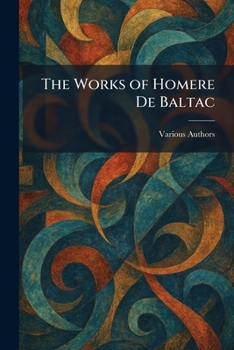
The Works of Homere De Baltac

Select Format
Select Condition 
Book Overview
"The Works of Honor de Balzac" presents a sweeping survey of the literary genius behind one of the most ambitious projects in the history of world literature. Renowned for his unparalleled ability to capture the intricacies of 19th-century French life, Balzac remains a towering figure of realism. This collection brings together his multifaceted narratives, which collectively aim to provide a complete picture of contemporary society through the lens of "The Human Comedy". From the bustling streets of Paris to the quiet struggles of the provinces, these stories examine the driving forces of human ambition, greed, passion, and morality.
As a master of characterization, Balzac populates his world with a vast cast of recurring figures, creating a dense social web that reflects the complexities of the post-Napoleonic era. His meticulous attention to detail and his profound understanding of the economic and social pressures that shape individual lives make these works essential reading for any lover of classic prose. This compilation showcases Balzac's unique talent for blending sharp social observation with intense psychological depth, ensuring his place as a foundational architect of the modern novel. Readers will find in these pages a timeless exploration of the human condition and a vibrant portrait of a nation in transition.
This work has been selected by scholars as being culturally important, and is part of the knowledge base of civilization as we know it. This work was reproduced from the original artifact, and remains as true to the original work as possible. Therefore, you may see the original copyright references, library stamps (as most of these works have been housed in our most important libraries around the world), and other notations in the work.
This work is in the public domain in the United States of America, and possibly other nations. Within the United States, you may freely copy and distribute this work, as no entity (individual or corporate) has a copyright on the body of the work.
As a reproduction of a historical artifact, this work may contain missing or blurred pages, poor pictures, errant marks, etc. Scholars believe, and we concur, that this work is important enough to be preserved, reproduced, and made generally available to the public. We appreciate your support of the preservation process, and thank you for being an important part of keeping this knowledge alive and relevant.
Customer Reviews
ThriftBooks ® and the ThriftBooks ® logo are registered trademarks of Thrift Books Global, LLC
