


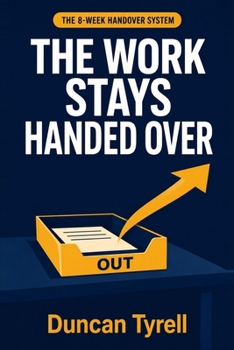
The Work Stays Handed Over

You handed it over in March. By May you were reviewing her emails before they went out. Nobody decided that. It just happened.
This is a book about one problem, and only one.
You give a piece of your job to somebody else. For a few weeks it holds. Then a quick question becomes two quick questions. An escalation lands on your desk because answering it was faster than explaining it. Six weeks later the work is back with you and nobody can say when it returned.
You have probably concluded you hired the wrong person. You have probably concluded that twice.
IT IS NOT A PEOPLE PROBLEM
Delegation fails for a structural reason: the task moves, and the decision stays with you. Anything that needs a judgement call still has to reach you, so the work routes back through you no matter who is nominally doing it.
That is fixable, and fixing it is mechanical rather than motivational.
WHAT THIS BOOK ACTUALLY GIVES YOU
- An inventory method - a two-week log that produces a real list of what you hold, sorted by whether it needs your judgement, your context, or only your hands
- Decision rights, written out - who decides what, within what limit, and what happens at the boundary. Complete with the exact wording, so a rule takes thirty seconds to write and answers the same question permanently
- Context transfer - how to get the reasons, the history and the near-misses out of your head, since nobody can decide well without what you never wrote down
- The eight-week handover sequence - watch, do together, do watched, do alone, report by exception
- What to do at the first mistake - the chapter that matters most, because this is where handovers die
- Reporting by exception - staying informed without staying involved
- The month-three failure modes - your open door, being cc'd, the client who insists on you, the approval you forgot to remove
WHO IT IS FOR
Owners of businesses with roughly five to forty people, who work too many hours, have tried this before and watched it fail. You are competent and tired. There is no motivation in this book because you do not need any.
A NOTE ON WHAT YOU WILL NOT FIND
No statistics, no cited studies, no client success stories, no promises that you will save a specific number of hours. Every scenario here is generic and illustrative. The arguments have to stand on their own reasoning, which is the standard this book is written to.
Customer Reviews
ThriftBooks ® and the ThriftBooks ® logo are registered trademarks of Thrift Books Global, LLC
