


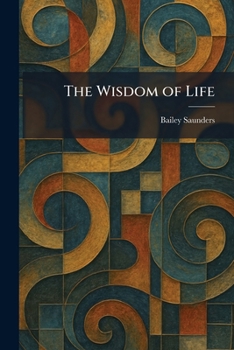
The Wisdom of Life

"The Wisdom of Life" is a profound exploration of human existence and the pursuit of contentment, translated from the works of the renowned philosopher Arthur Schopenhauer by T. Bailey Saunders. This influential treatise departs from abstract metaphysics to offer a practical inquiry into how one might achieve a tranquil life amidst the inherent struggles of the human condition. Schopenhauer organizes his observations into three core categories: what a man is (his personality and character), what a man has (his material wealth), and how a man is perceived by others (his reputation and status).
The text argues that true fulfillment is found within the individual-specifically through health, intellect, and temperament-rather than through the fleeting satisfaction of external possessions or social validation. Written with characteristic wit and a touch of realism, the work examines the vanities of social life and the importance of intellectual independence. As a foundational text of 19th-century thought, "The Wisdom of Life" remains a vital guide for readers interested in ethics, psychology, and the art of living well. It continues to resonate as a powerful defense of self-sufficiency and the contemplative life in an often superficial world.
This work has been selected by scholars as being culturally important, and is part of the knowledge base of civilization as we know it. This work was reproduced from the original artifact, and remains as true to the original work as possible. Therefore, you may see the original copyright references, library stamps (as most of these works have been housed in our most important libraries around the world), and other notations in the work.
This work is in the public domain in the United States of America, and possibly other nations. Within the United States, you may freely copy and distribute this work, as no entity (individual or corporate) has a copyright on the body of the work.
As a reproduction of a historical artifact, this work may contain missing or blurred pages, poor pictures, errant marks, etc. Scholars believe, and we concur, that this work is important enough to be preserved, reproduced, and made generally available to the public. We appreciate your support of the preservation process, and thank you for being an important part of keeping this knowledge alive and relevant.
Related Subjects
PhilosophyCustomer Reviews
ThriftBooks ® and the ThriftBooks ® logo are registered trademarks of Thrift Books Global, LLC
