


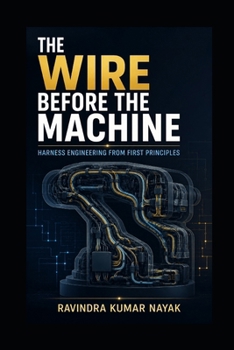
The Wire Before the Machine: Harness Engineering from First Principles

Most people see the machine.
Very few learn to see the hidden paths that help it work.
Inside a scooter, robot, appliance, control panel, vehicle, or electronic system, a wiring harness quietly carries power, signals, return paths, protection, and trust. When it works well, most people never notice it. When it fails, the entire machine can become confusing.
The Wire Before the Machine is a beginner-friendly introduction to wiring harness and cable harness engineering from first principles.
This book does not begin with complex drawings, advanced calculations, or dry component lists. It begins with the simple question every learner needs first:
What must the machine do, and what path allows it to happen?
Through clear explanations, practical examples, visual learning, guided reflection, and natural mentor-student conversations, this book helps readers understand why wires exist, why paths must be controlled, why connectors matter, why insulation protects more than appearance, why routing is a serious engineering decision, and why testing is not a formality.
You will learn how to think about:
the need before the wirepower, signal, ground, and return pathswire purpose and selection thinkinginsulation as a boundaryterminals as reliable contact pointsconnectors as controlled meeting placesprotection, support, and routingbranches and breakoutslabels, drawings, and engineering memorytesting as prooffailure as useful informationsafe beginner practice through observation and paper exercisesThis is not a replacement for official standards, professional safety training, company procedures, or supervised hands-on instruction. It is a foundation book designed to help beginners build the mental map they often miss when technical subjects are explained too late, too fast, or too narrowly.
If you are a student, technician, fresh engineer, career switcher, robotics learner, automotive learner, EV beginner, electronics learner, or curious reader who wants to understand what wiring harnesses actually do inside machines, this book gives you a calm first path in.
By the end, a harness should no longer look like a confusing bundle.
It should look like a planned system of purpose, path, protection, and proof.
Customer Reviews
ThriftBooks ® and the ThriftBooks ® logo are registered trademarks of Thrift Books Global, LLC
