


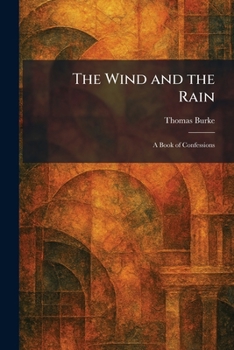
The Wind and the Rain: A Book of Confessions

Select Format
Select Condition 
Book Overview
"The Wind and the Rain: A Book of Confessions" is a lyrical and evocative autobiographical work by Thomas Burke, the celebrated chronicler of London's East End. Moving beyond the gritty realism of his earlier short stories, this narrative provides a deeply personal exploration of the author's formative years, charting a journey from a childhood of poverty in Limehouse to the beginnings of his literary career. Through a series of reflective vignettes, Burke captures the atmosphere of early 20th-century London, blending descriptions of the fog-drenched streets and the vibrant, often harsh, reality of the docks with an introspective look at his own developing artistic consciousness.
The work serves as both a memoir and a prose poem, highlighting themes of loneliness, ambition, and the transformative power of literature. Burke's prose is noted for its rhythmic beauty and emotional sincerity, offering readers a poignant glimpse into the struggles and inspirations that shaped one of the most distinctive voices in British urban literature. By weaving together personal confession with atmospheric travelogue, "The Wind and the Rain: A Book of Confessions" stands as a significant contribution to the tradition of London writing, preserving a vanished world through the eyes of a sensitive observer who found beauty in the shadows of the city.
This work has been selected by scholars as being culturally important, and is part of the knowledge base of civilization as we know it. This work was reproduced from the original artifact, and remains as true to the original work as possible. Therefore, you may see the original copyright references, library stamps (as most of these works have been housed in our most important libraries around the world), and other notations in the work.
This work is in the public domain in the United States of America, and possibly other nations. Within the United States, you may freely copy and distribute this work, as no entity (individual or corporate) has a copyright on the body of the work.
As a reproduction of a historical artifact, this work may contain missing or blurred pages, poor pictures, errant marks, etc. Scholars believe, and we concur, that this work is important enough to be preserved, reproduced, and made generally available to the public. We appreciate your support of the preservation process, and thank you for being an important part of keeping this knowledge alive and relevant.
Customer Reviews
ThriftBooks ® and the ThriftBooks ® logo are registered trademarks of Thrift Books Global, LLC
