


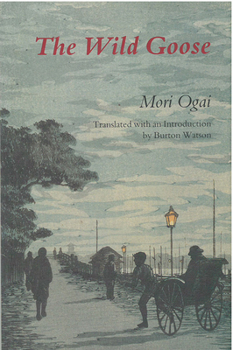
The Wild Goose: Volume 14


Select Format
Select Condition 
Book Overview
Mori Ōgai (1862-1922), one of the giants of modern Japanese literature, wrote The Wild Goose at the turn of the century. Set in the early 1880s, it was, for contemporary readers, a nostalgic return to a time when the nation was embarking on an era of dramatic change. Ōgai's narrator is a middle-aged man reminiscing about an unconsummated affair, dating to his student days, between his classmate and a young woman kept by a moneylender. At a time when writers tended to depict modern, alienated male intellectuals, the characters of The Wild Goose are diverse, including not only students preparing for a privileged intellectual life and members of the plebeian classes who provide services to them, but also a pair of highly developed female characters. The author's sympathetic and penetrating portrayal of the dilemmas and frustrations faced by women in this early period of Japan's modernization makes the story of particular interest to readers today. Ōgai was not only a prolific and popular writer, but also a protean figure in early modern Japan: critic, translator, physician, military officer, and eventually Japan's Surgeon General. His rigorous and broad education included the Chinese classics as well as Dutch and German; he gained admittance to the Medical School of Tokyo Imperial University at the age of only fifteen. Once established as a military physician, he was sent to Germany for four years to study aspects of European medicine still unfamiliar to the Japanese. Upon his return, he produced his first works of fiction and translations of English and European literature. Ōgai's writing is extolled for its unparalleled style and psychological insight, nowhere better demonstrated than in The Wild Goose.
Format:Paperback
Language:English
ISBN:0939512718
ISBN13:9780939512713
Release Date:November 1995
Publisher:U of M Center for Japanese Studies
Length:180 Pages
Weight:0.65 lbs.
Dimensions:0.6" x 6.0" x 9.0"
Customer Reviews
3 ratings
Classic Japanese Lit
Published by Thriftbooks.com User , 18 years ago
Wild Geese is considered a classic in Japanese literature. I started reading modern Japanese literature when we lived in Ukraine, and English language books were a rare find. Wild Geese is a story of both making opportunities and just-missed opportunities. The story revolves around a student and a concubine and the people in their lives, and is not one to read when you are in a happily-ever-after mood. Then again, Japanese lit rarely is.
The coflict between love and surperstition!!
Published by Thriftbooks.com User , 25 years ago
This love story of a girl who became a lover of an old bill collecter and fall in love with a medical student is a sign of japanese mentality in the drastic changing situation between the periode "Edo" and periode "Meiji". As his first novel "Dancer"in wich he told his uncompleated love in Germany(at that time,having a foreign wife was a taboo), Mori tried to show the example of a conflict of natural feeling of love and the traditional superstition.Why the girl could not acheave her love? In Japan they said that a real love is a love forbidden, but it is sure that what Mori wanted to say in this book is not that beauty.
Zero Reciprocity
Published by Thriftbooks.com User , 27 years ago
One small incident CAN be made into an entire novel, as Ogai Mori shows us here. The actual action in The Wild Goose is quite small, even insignificant. But the way Ogai informs us of every thought of every character more than makes up for it. What I found to be truly compelling was the point of view -- the narrator is the best friend of Okada, one of the main characters. Just when it appears that the narrator knows way too much about what Otama (the girl) was thinking, he goes and leaves us with a mystery at the end that brings about what I thought was excellent closure. I would say that the main theme of this novel is "zero reciprocity" -- those of the characters who are in love are never truly loved back, like Otama, who silently longs for Okada, or even Suezo, the man who has taken Otama for his mistress. In this novel, people lie, people cheat, people hide the truth. And people never say what they truly feel. Just like real life. An excellent story.
Copyright © 2026 Thriftbooks.com Terms of Use
| Privacy Policy | Do Not
Sell/Share My Personal Information | Cookie Policy | Cookie Preferences | Accessibility Statement
ThriftBooks® and the ThriftBooks® logo are registered trademarks of Thrift Books Global, LLC
ThriftBooks® and the ThriftBooks® logo are registered trademarks of Thrift Books Global, LLC
