


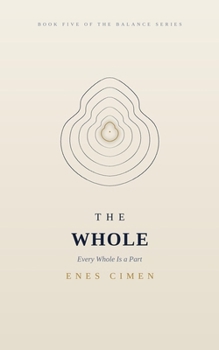
The Whole: Every Whole Is a Part

Why should the same law govern a forest and a mood?
Across the Balance Series, Enes Cimen drew evidence from wildly unrelated places - a wildfire, a market, a marriage, a cell - and readers found the range convincing. But nobody asked why a principle discovered in an ecosystem should say anything about a human life. The Whole answers it, and the answer reframes everything that came before.
They were never four laws. They are one structure seen from four angles - and the structure is nesting. Wholes made of wholes, contained by wholes, at every scale anyone has ever examined. Balance is what such a system does when disturbed. The wave is that response over time. The wind is the same system seen at the level of one component instead of the aggregate. The fire is what happens when its own stability traps it.
And you are one of them: a whole when you look down at what composes you, a part when you look up at what contains you - permanently both.
From emergence (why no single molecule has a temperature, and why that matters) to the practical diagnostic at the heart of the book - which doll? - The Whole turns nested structure into a working tool. Why the absence of a correction in your own life is not evidence that none exists. Why the most seductive error in human thought is insisting that only one scale is real. What you owe the parts that compose you, and the systems you did not build. And why the upper levels have no hands but ours.
It closes where the series began: at the outermost doll no one has ever seen. That question is not answered here - our position makes it unanswerable - but something more useful is found in its place: its answer would change nothing about how to live.
The fifth and final book of the Balance Series.
No equations. Nothing padded. Nothing claimed beyond what can honestly be defended.
Customer Reviews
ThriftBooks ® and the ThriftBooks ® logo are registered trademarks of Thrift Books Global, LLC
