


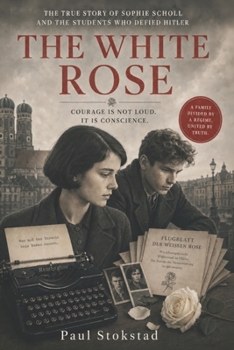
The White Rose

Sophie Scholl was only twenty-one when Nazi Germany executed her for distributing anti-Hitler leaflets at the University of Munich.
But she was not born a symbol. She was a daughter, sister, student, believer, and young woman who had once been drawn, like many German children, toward the songs, hikes, uniforms, and belonging offered by the regime's youth organizations. Her courage grew through family, faith, disillusionment, books, war, friendship, and the refusal to keep looking away.
The White Rose tells the story of Sophie, her brother Hans, and the student resistance circle that dared to oppose Hitler with paper, ink, street slogans, and conscience. Richly dramatic but grounded in history, this narrative follows the Scholl family, the intellectual world around Hans and Sophie, the first leaflets, the Eastern Front, the Munich atrium, the interrogation rooms, the trial, and the final afternoon at Stadelheim Prison.
The White Rose students could not stop the war. They could not topple the Reich. But they left behind something the regime could not destroy: proof that courage was possible.
Customer Reviews
ThriftBooks ® and the ThriftBooks ® logo are registered trademarks of Thrift Books Global, LLC
