


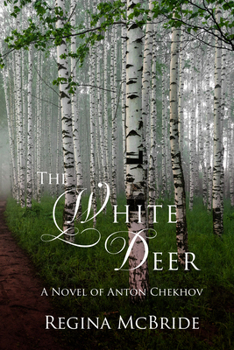
The White Deer: A Novel of Anton Chekhov

In the summer of 1879, on his way to Moscow to study medicine, 19-year-old Anton Chekhov, from a bankrupt merchant class family, stops to spend a restful few weeks in the Ukrainian countryside, staying with his friend, Dr. Mitrofan, who is worried about Anton's lingering bronchitis. It is here that Anton meets Vera Denisova, also 19, a budding actress, the daughter of theater aristocrats from Volkhov, a neighboring estate. The two spend much of their time wandering Volkhov's vast property, hoping for a glimpse of a white deer that has been spotted in the back acreage.
As they grow closer, Vera confides in Anton about her secret romance and heartbreak over Petya, a servant her age who was gifted at drawing and who she helped to acquire an apprenticeship as a draughtsman in order to leave servitude for good. Anton is fascinated by her obsession, and a triangle forms between Vera, Anton, and the absent Petya. Anton, too, shares his secrets with her, his conflicted relationship with his indigent family and his frustrated wish to publish stories. Surreptitiously through Anton, Vera learns the truth about her family's declining financial situation and the impending loss of her beloved childhood estate. Together in the long, extended light of summer days, Vera and Anton struggle to come to terms with their feelings for each other and the new profoundly changed world that is waiting for each of them at summer's end.
The final section of the novel charts the correspondence between Vera and Anton over the next two decades. Vera has become a successful actress and Anton, a doctor who treats peasants for free, has more than realized his ambition as a writer. In a final letter to Vera before his death at 44 of tuberculosis, Anton reveals that his play, The Cherry Orchard, was inspired by his time with her at Volkhov.
Customer Reviews
ThriftBooks® and the ThriftBooks® logo are registered trademarks of Thrift Books Global, LLC
