


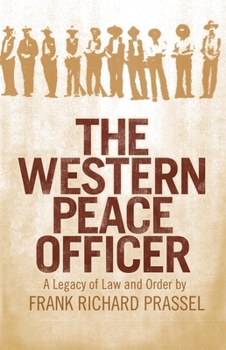
The Western Peace Officer: A Legacy of Law and Order

Select Format
Select Condition 
Book Overview
The role of the lawman in the development of the American West has been distorted by an overabundance of dime novels, pulp westerns, Hollywood films, and television programs. Myth has merged with reality, and the stereotype of the badge-packing, gun-wielding marshal has gained complete acceptance in the popular mind. Examining the legends that surround the western peace officer, Professor Prassel argues that he was no better or worse than the members of the community he served. His work was largely routine. Only after journalists and novelists glorified him beyond all recognition did he acquire the resplendent finery and flamboyant manner now common to the cinematic hero. This book describes the activities of a number of law-enforcement agencies. Each level of civil administration in the West had its own police force. Banks, railroads, and cattlemen's associations hired private detectives, and Indian police patrolled reservations. Pinkerton men, Texas rangers, Canadian mounties, and Mexican rurales all played a part in western law enforcement. Men like Dallas Stoudenmire, James Butler Hickok, and Wyatt Earp are discussed, together with more colorful but less publicized figures like Frank Wattron, one-time sheriff of Navajo County, Arizona. Wattron, who ran a drugstore and tended bar, wore a diamond-encrusted badge of solid gold. He once announced a hanging by sending invitations that promised "the latest improved methods in the art of strangulation ... to make the surroundings cheerful and the execution a success." Despite a century of effort, the peace officer failed to bring law and order to the American West. Outdated police methods and antiquated statutes may help to explain why the West is more violent and crime-ridden today than when the frontier was new. By considering such problems, Professor Prassel's book acquires a particular significance for our times.
Format:Paperback
Language:English
ISBN:0806116943
ISBN13:9780806116945
Release Date:December 1980
Publisher:University of Oklahoma Press
Length:348 Pages
Weight:1.00 lbs.
Dimensions:0.9" x 5.5" x 8.0"
Related Subjects
19th Century History Political Science Politics & Social Sciences Social Sciences WorldCustomer Reviews
1 rating
A must for police history buffs
Published by Thriftbooks.com User , 17 years ago
This is one of the best histories of American law enforcement in a long time. The author begins with an overview of the history of law enforcement going back to the beginnings of law in ancient times. He traces the development of policing in Europe and in the commom law tradition of England from Saxon times to the 19th century and the establishment of the Metropolitan Police. He then gives an overview of policing in colonial times to the establisment of modern police forces in the cities and states. The bulk of the book is about the myriad of policing agencies that developed in our West. They are all here: sherrifs, town marshals, US Marshals in the territories, even the private Pinkertons. He also covers the state organizations such as the Arizona and Texas Rangers. Western law was fairly libertarian, everyone was given the right to make arrests, law enforment was not monopolized as it is today. He even discusses the role of the US Army in policing the West, and even the development of the police of the Indian tribes. If you are interested in Police history or are a police buff, this book is a must have.
Copyright © 2026 Thriftbooks.com Terms of Use
| Privacy Policy | Do Not
Sell/Share My Personal Information | Cookie Policy | Cookie Preferences | Accessibility Statement
ThriftBooks® and the ThriftBooks® logo are registered trademarks of Thrift Books Global, LLC
ThriftBooks® and the ThriftBooks® logo are registered trademarks of Thrift Books Global, LLC
