


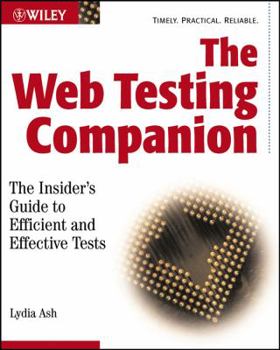
The Web Testing Companion: The Insider's Guide to Efficient and Effective Tests

Written by one of Microsoft's key testing trainers, this hands-on tutorial and reference explains why, when, what, and how to test Teaches new and experienced testers how to analyze and properly test Web applications Filled with practical advice that can be immediately applied to any Web-testing task, on any browser running on any platform Concentrates on proven solutions and presents the material in a way that will help develop a professional skill set in novice testers and will improve the productivity of all testers Companion Web site includes dozens of valuable templates and test patterns that will allow readers to rapidly conduct tests in multiple languages against all browser and operating-system combinations
Format:Paperback
Language:English
ISBN:0471430218
ISBN13:9780471430216
Release Date:May 2003
Publisher:Wiley
Length:600 Pages
Weight:1.95 lbs.
Dimensions:9.3" x 1.2" x 7.4"
Customer Reviews
5 ratings
Straightforward, practical approach to web testing.
Published by Thriftbooks.com User , 19 years ago
Lydia's book is probably the best written web testing book in the market. The prose is easy to follow, progressive, non-verbose, and sometimes even inspiring. She painfully explicates various testing principles with exacting examples. Published in 2003, some of the examples already show their age but the testing principles and problems are still current. Web technologies have evolved immensely in the last three years and this book would benefit from such updates in a second edition.
Good Reference
Published by Thriftbooks.com User , 20 years ago
The Web Testing Companion is a manual written for both beginners and experienced web designers, and the author herself is a testing director at Microsoft. If you've had a few years' experience as a designer, developer or webmaster, then the material is not new to you; i.e., optimizing bandwidth, etc. Obviously, this is not the kind of book you read straight through from beginning to end, but rather a handbook that you can refer to as problems arise. For the most part, the book succeeds as that, and Ms. Ash has divided the book into four general sections: non-technical issues, technical issues, general advice for testers, and finally an excellent set of appendices on various aspects of Web testing. I'm sure we all can recall incidents of working with defective software that nobody apparently had tested for bugs, sloppy coding, or slow operating time. This was because there was probably a deadline for the software release time, and the developer concluded that hiring testers would be an extra expense. Non-Technical Issues: The first four chapters deal with non-technical issues, mostly related to the planning of the application. Web site planning can involve a number for goals; for example, which is most important: minimal defects or time-to-market? Developing a medical web application to assist in diagnosing illnesses is different from developing an application that will be used to solicit funds. The medical app could be providing life-or-death information, whereas the solicitation site could need high visual appeal. In other words, the app must meet the customer's requirements and expectations, not yours. Most of us already know that, but in one of the book's appendices, the author has given us a checklist of several pages worth of questions to determine exactly what the customer's needs are. That's what I like about this book: It presents some very objective methods for answering subjective questions. Server-Side and Client-Side Testing: For server-side (as opposed to client-side) web apps, performance testing and security testing are the most important. Stability problems need to be identified prior to deployment. The tester, therefore, should create many user scenarios derived from the most common and most intensive user actions, and then analyze the performance statistics after the performance tests are completed. The author recommends that all of your pages load in 15 seconds or less, but this rule really depends on your particular application and the expectations of the people using it. If your app requires large graphics and the users are architects, they will probably feel that waiting a few minutes is worth the effort. Testing Scenarios: The author recommends that you set up a test environment that is separate from your development and production environment. This can include a separate web server, database server, and application server if applicable. This is especially important in testing security features. (It should be note
Excellent Web QA resource
Published by Thriftbooks.com User , 20 years ago
This is the best book I have ever seen on the testing web applications. It covers everything from unicode to Javascript, from security to the validity of the HTML. It teaches through an understanding of the technology, then covers ways to stress the technology to look for bugs. The sections on character encodings and performance testing are particularly well done. This is a must have book for QA professionals tasked with testing a web application.
Take the title literally
Published by Thriftbooks.com User , 21 years ago
This book is overshadowed by "Testing Applications on the Web: Test Planning for Mobile and Internet-Based Systems" ISBN 0471201006, which is one of the most highly regarded in the testing community. However, that does not mean this book is without merit. On the contrary, the rich content of the appendices, which comprise a significant portion of this work, make it an ideal companion to the aforementioned book.Another point in this book's favor is that it is basic enough and structured to make it an ideal text for a course on web testing. The author did an excellent job of describing good practices in web testing and covering the basics. She also provides a good deal of sage advice on careen matters, which a more technical book will overlook.I found the chapters on server-side testing accurate and clear enough for new test professionals to completely follow. The chapters on performance and security testing were reasonably complete, and the chapters on client side were as well and clearly written. I also like the author's objectivity - she works for Microsoft, but did not emphasize that company's technologies or processes over standard industry practices.As a supplement to a more technical book, such as the one I cited above, or as a text in a basic web testing course this book shines. It is not the definitive reference, but is worth reading if for no other reason than to have the appendices nearby as a ready reference during test cycles.
An excellent web testing reference
Published by Thriftbooks.com User , 21 years ago
I came across this book in the bookstore and was so impressed I dropped the $$$ on it there. I have referred to it at least weekly for test cases. It has more than paid for the purchase price through what it has done to make my job easier. Few books touch on security or performance in a practical manner, but this one digs right in and actually has information you can apply immediately to your app. I can see where the other reviewer might have been frustrated in that it didn't tell him how to write web applications. It is purely about testing them and doesn't get hung up walking you through any specific technologies. It concentrates on the information you need to test your app.Don't take my word for it. Stickyminds gave it 4 stars. ...
Copyright © 2025 Thriftbooks.com
Terms of Use | Privacy Policy | Do Not Sell/Share My Personal Information | Cookie Policy | Cookie Preferences | Accessibility Statement
ThriftBooks ® and the ThriftBooks ® logo are registered trademarks of Thrift Books Global, LLC
ThriftBooks ® and the ThriftBooks ® logo are registered trademarks of Thrift Books Global, LLC
