


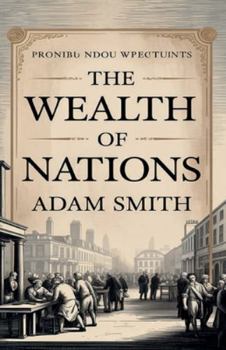
The Wealth of Nations

The Wealth of Nations is a groundbreaking work that laid the foundation for modern economics and political theory. Published in 1776, Adam Smith's seminal treatise explores the nature of wealth, the principles of market economies, and the role of government in economic affairs. Through sharp analysis and insightful commentary, Smith examines the mechanisms that drive economic growth, the division of labor, and the benefits of free markets.At the heart of this influential work is Smith's argument for the "invisible hand"-the idea that individuals pursuing their own self-interest unintentionally contribute to the greater good of society. He also explores the dynamics of international trade, the importance of competition, and the limits of government intervention. His critiques of mercantilism and advocacy for laissez-faire policies shaped economic thinking for centuries.The Wealth of Nations not only revolutionized economics but also had a profound impact on political philosophy, helping to define the relationship between individual liberty, government regulation, and the pursuit of national prosperity.Whether you're a student of economics, a scholar of political theory, or simply someone curious about the forces that shape the world's economies, The Wealth of Nations remains an essential text for understanding the principles that govern economic life.
Format:Paperback
Language:English
ISBN:B0FPNH6T1V
ISBN13:9788199009912
Release Date:April 2021
Publisher:Milky Way Publications
Length:762 Pages
Weight:1.91 lbs.
Dimensions:1.7" x 5.5" x 8.5"
Customer Reviews
1 rating
Economics, history, and life are not individual subjects.
Published by bernie4444 , 29 days ago
All my life, I have been bombarded with one economist versus another. Each time, Adam Smith always showed up. So, after hearing snippets of his book and his ideas repeatedly, I thought, “Ah, I know Adam Smith.”
Well, I might have been a tad premature in thinking that I knew Adam Smith. You will too when you read this book, “An Inquiry into the Nature and Causes of the Wealth of Nations.”
I figured that it was finally time to read Adam Smith for myself instead of taking snippets out of context.
At first, I began to think that I had made a big mistake. If you read the Constitution of the United States, you would notice that you are always told the impressive parts as separate statements, and they leave out all the boring details and sometimes important minutiae. Well, it looks like they did the same thing to poor Adam.
On the surface, as you start reading this book, you start to wonder what makes Adam Smith so important, as it seems so primitive. Reading on, you realize that he came from an era that was way before the information age. His samples seem primitive and simple. He repeats and repeats and repeats himself. You start to wonder if this is the same Adam Smith that you studied in school.
You will want to hang in there, though, as soon as you realize that Adam Smith had to start with the fundamentals of history and primitive economics. After pages of history, he will finally get to his time.
Yes, this is a book about ancient times, and the examples are not usually relevant to today. However, just as you decide that you made a horrible mistake in reading “An Inquiry into the Nature and Causes of the Wealth of Nations,” small jewels of insight into not only economics and history but life itself reveal themselves in his everyday descriptions and observations.
I had to buy a book on the English poor laws, as everybody knew about them. Many other subjects and reference books suddenly appeared on my desk as I realized that with all the depth of Adam Smith, this was just the beginning.
Yes, sometimes Smith can get boring and very redundant. However, whatever you do, do not skip any pages just because you know what he is going to say; he produces another interesting angle.
He not only covers economics from his version of a practical perspective but also covers the history of education and many other subjects besides commerce. He covers the effect of religions on people and people on religions. He covers schools, how they got started, and their potential for modifying society. He covers the economics of war and other major world-changing phenomena.
Just as you think he is talking about his world and his time. You pick up a newspaper and see the very same type of events and economic arguments.
For me, of all things, I was able to get a new view of the national debt, and it changed my view from unavoidable to an excellent opportunity.
You will find new insights or views on economics that you were already sure you had under your belt.
So, enjoy reading Adam Smith not as a necessity but for the fun of getting new views directly from the author.
Copyright © 2026 Thriftbooks.com
Terms of Use | Privacy Policy | Do Not Sell/Share My Personal Information | Cookie Notice | Cookie Preferences | Accessibility Statement
ThriftBooks ® and the ThriftBooks ® logo are registered trademarks of Thrift Books Global, LLC
ThriftBooks ® and the ThriftBooks ® logo are registered trademarks of Thrift Books Global, LLC
