


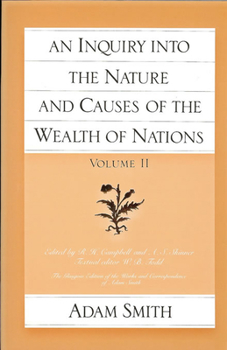
An Inquiry Into the Nature and Causes of the Wealth of Nations (Vol. 2)

Select Format
Select Condition 
Book Overview
Volume 2
Format:Paperback
Language:English
ISBN:0865970076
ISBN13:9780865970076
Release Date:January 1981
Publisher:Liberty Fund, Incorporated
Length:535 Pages
Weight:1.95 lbs.
Dimensions:1.4" x 6.0" x 9.0"
Age Range:18 years and up
Grade Range:Grades 12 to 5
Related Subjects
Capitalism Industrial Revolution Wealth Creation Business Business & Investing HistoryCustomer Reviews
6 ratings
Economics, history, and life are not individual subjects.
Published by bernie4444 , 16 days ago
All my life, I have been bombarded with one economist versus another. Each time, Adam Smith always showed up. So, after hearing snippets of his book and his ideas repeatedly, I thought, “Ah, I know Adam Smith.”
Well, I might have been a tad premature in thinking that I knew Adam Smith. You will too when you read this book, “An Inquiry into the Nature and Causes of the Wealth of Nations.”
I figured that it was finally time to read Adam Smith for myself instead of taking snippets out of context.
At first, I began to think that I had made a big mistake. If you read the Constitution of the United States, you would notice that you are always told the impressive parts as separate statements, and they leave out all the boring details and sometimes important minutiae. Well, it looks like they did the same thing to poor Adam.
On the surface, as you start reading this book, you start to wonder what makes Adam Smith so important, as it seems so primitive. Reading on, you realize that he came from an era that was way before the information age. His samples seem primitive and simple. He repeats and repeats and repeats himself. You start to wonder if this is the same Adam Smith that you studied in school.
You will want to hang in there, though, as soon as you realize that Adam Smith had to start with the fundamentals of history and primitive economics. After pages of history, he will finally get to his time.
Yes, this is a book about ancient times, and the examples are not usually relevant to today. However, just as you decide that you made a horrible mistake in reading “An Inquiry into the Nature and Causes of the Wealth of Nations,” small jewels of insight into not only economics and history but life itself reveal themselves in his everyday descriptions and observations.
I had to buy a book on the English poor laws, as everybody knew about them. Many other subjects and reference books suddenly appeared on my desk as I realized that with all the depth of Adam Smith, this was just the beginning.
Yes, sometimes Smith can get boring and very redundant. However, whatever you do, do not skip any pages just because you know what he is going to say; he produces another interesting angle.
He not only covers economics from his version of a practical perspective but also covers the history of education and many other subjects besides commerce. He covers the effect of religions on people and people on religions. He covers schools, how they got started, and their potential for modifying society. He covers the economics of war and other major world-changing phenomena.
Just as you think he is talking about his world and his time. You pick up a newspaper and see the very same type of events and economic arguments.
For me, of all things, I was able to get a new view of the national debt, and it changed my view from unavoidable to an excellent opportunity.
You will find new insights or views on economics that you were already sure you had under your belt.
So, enjoy reading Adam Smith not as a necessity but for the fun of getting new views directly from the author.
Get the edition having Edwin Cannan as editor
Published by Thriftbooks.com User , 21 years ago
Just as some editions of The Wealth of Nations should be avoided because of undisclosed abridgement (see reviewers below), other editions ought to be sought out and preferred. Look for versions involving Edwin Cannan as editor. These include the University of Chicago edition (1976) in paperback and the Modern Library edition (1994) in hardcover. (To my knowledge, neither of these editions is abridged.) In 1904, Cannan, a professor at the London School of Economics, did two things that greatly add to the value of Smith's book. First, Cannan prepared a detailed index. For example, "invisible hand" appears in it. Just try to find the one (and only one) appearance of that phrase without an index. Most of the non-Cannan editions I've looked at lack an index. Second, Cannan wrote and added brief marginalia. His words facilitate skimming, something most readers of this thousand page book are apt to do. His words and phrases are also easily ignored. They don't get in your way once you've found the pages you want to read. (Reviewer T. Grimes comments on the marginalia as well.) Finally, reading The Wealth of Nations shows Smith to be different from his usual portrayal. He can be wickedly satirical. Anyone who has been to college will recognize much that is familiar in his thoughts (in Book V) on "Education of Youth". And he also frankly addresses the downsides of capitalism. The book begins with the division of labor as a powerful means of adding productivity. But later (pp. 839-41 in my Modern Library edition), he recognizes the destructive effects of division of labor and, in response, recommends government investment in public education. As one who once earned a good living as a computer programmer, and who is now retraining, I am finding perennial relevance in The Wealth of Nations.
The Bible of Economics
Published by Thriftbooks.com User , 23 years ago
To be an economist without having read "The Wealth of Nations" is like being a priest without having read the Bible. As is often the case with second hand accounts, textbooks have distorted and watered down Adam Smith. Going back to the original text is both refreshing and enlightening.The "Wealth of Nations" remains the most truthful defense of the economic science. But remember that Adam Smith also wrote "The Theory of Moral Sentiments"; for Smith, economics was a search to better people's life rather than simply a quest to optimize mathematical functions or estimate variables using econometric models. To simply associate Smith with expressions such as the "invisible hand," does not do him justice. Take, for example, the opening chapter on the division of labor: first, Smith defends the division of labor as being efficient; then, he defends it as an essential component of the freedom to allocate one's labor to one's talents; finally, he links the division of labor to trade: without the freedom to exchange the fruits of one's labor, the division of labor is meaningless. The point is that Adam Smith defends the rationale for the market, rather than just explain its mechanics.Anyone studying economics in school would think that economics is all about efficiency; this preoccupation, inevitably, breeds economists who support the market simply because it works. But to read Adam Smith is to enter the realm of an economic science where the ultimate benchmark is not efficiency but human freedom and welfare. That is, probably, what Smith would remark if he were to sit in an economics class today, and why the "Wealth of Nations" is as revolutionary today as it was two centuries ago.
The Y2K - Modern Library Classics Version
Published by Thriftbooks.com User , 25 years ago
I am reviewing the Modern Library Classics version with an introduction by former labor secretary Robert Reich. To minimize repetition, the differences for this version: This massive book is complete and unabridged (all five books). There is a great added feature in the form of small summary notes in the margin that accompany each paragraph. Adam Smith was a masterful writer of prose and communicates some of the most important economic and philosophical ideas in the history of western civilization. Economic theory never read so beautifully. An interesting choice for an introduction is Robert Reich. He is one of the few intellectuals from the left, and while I disagree with him more often than not, I respect his thought process. He offers his interpretation of Smith and how the ideas found in TWoN fit neatly with his positions. Selective reasoning or not, Reich does offer a nice summary line: "In these times, as when Adam Smith wrote, it is important to remind ourselves of the revolutionary notion at the heart of Smith's opus-that the wealth of a nation is measured not by its accumulated riches, but by the productivity and living standards of all its people." Nicely said and I agree. I just disagree with Reich and his ilk on how the "wealth" of the modern nation is achieved. Adam Smith offers the roadmap, but it is up to us to keep lawmakers in DC or [insert any central government here] from regulating and taxing us to death --relegating Smith's work to the dust bin.
The only great seminal work I found lucid and persuasive
Published by Thriftbooks.com User , 26 years ago
When I was twenty I set out to read the seminal works of a wide range of disciplines. I read Darwin, Newton, Einstein, Hobbes, Machiavelli, Plato, Aristotle, Levi-Strauss, Jung, Campbell, Freud, Frazer (abridged), Epictetus, Keynes, Adam Smith, and others I can't remember. In most cases I was disappointed. I realised that in many cases the first exposition of an idea is difficult and obscure, and that it is the later, summarising writers who collect the best and clearest explanations of profound thoughts.The exception was Adam Smith's 'Wealth of Nations'. Only later did I discover that he began his amazingly varied academic career as a teacher of English prose style. It came as no surprise.Smith's writing is a brilliant as Gibbon, but even more lucid. His insight is profound. And his marvellous style of explanation makes the reader feel like a genius. Somewhat to my astonishment, the only part of his argument that I found at all difficult was the section on international exchange, which I had to translate from terms of flow of specie to terms of exchange rates of fiat currencies. Of all that stuff I read that year, Smith's 'Wealth of Nations' was the clearest, most persuasive, and most inspiring.It is because of Smith that the next year I took up the study of economics at the Australian National University. I came first in my class: my prize? A copy of 'The Wealth of Nations', much appreciated.
How to lift a nation out of poverty
Published by Thriftbooks.com User , 26 years ago
Adam Smith's Wealth of Nations brilliantly analyzes how a nation's living standards can be raised. In large part his wisdom still applies today. To briefly summarize Smith's thinking:1. Standards of living are determined by the productivity of workers. 2. Productivity of workers is greatly enhanced by specialization (see the famous example of the pin factory in the first chapter!).3. Greater specialization is possible only if the market size grows. Thus, government laws that prohibit growth of the market hurt specialization, and thereby keep living standards from rising. This is why Smith opposed laws that restricted trade or created monopolies. Smith actively worked to keep Britain from going to war against its American colonies over trade issues. The Wealth of Nations is a political tract designed to sway the British parliament (obviously it failed in that regard).4. Productivity of workers is enhanced by raising their wages. 5. Productivity of workers is enhanced by publicly funded education.6. The role of markets is exquisitely analyzed by Smith. Self-interest leads people to carry out private activities that lead to social betterment, as if by an "invisible hand." 7. It is a serious misinterpretation of Smith to assert that greed or selfishness is the same as self-interest. Smith labored hard to avoid any such confusion. Please see his other book which addresses this specific issue: The Theory of Moral Sentiments.8. Clearly Smith favored limited government. But Smith was NOT a strict advocate of laissez-faire. He ended his illustrious career as commissioner of customs, a job he took seriously, and which he would not have taken had he not thought this level of intervention in the economy warranted.Read the first three chapters of WN: they contain the essence of the arguments above. Then look in the index to find reference to the "invisible hand" "monopoly" "colonies" and other subjects of interest.Buy the GLASGOW EDITION of the Wealth of Nations. This is the most up-to-date annotated version. It is available (very cheaply) from the Liberty Fund Press in America. If you only want one copy, that is the only one to buy today.
Copyright © 2026 Thriftbooks.com
Terms of Use | Privacy Policy | Do Not Sell/Share My Personal Information | Cookie Policy | Cookie Preferences | Accessibility Statement
ThriftBooks ® and the ThriftBooks ® logo are registered trademarks of Thrift Books Global, LLC
ThriftBooks ® and the ThriftBooks ® logo are registered trademarks of Thrift Books Global, LLC
