


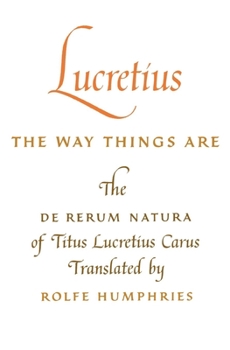
Lucretius: The Way Things Are: The de Rerum Natura of Titus Lucretius Carus


Select Format
Select Condition 
Book Overview
" . . . [captures] the relentless urgency of Lucretius' didacticism, his passionate conviction and proselytizing fervour.' --The Classical Review
Format:Paperback
Language:English
ISBN:025320125X
ISBN13:9780253201256
Release Date:January 1968
Publisher:Indiana University Press (Ips)
Length:256 Pages
Weight:0.63 lbs.
Dimensions:0.7" x 5.1" x 7.9"
Grade Range:Postsecondary and higher
Customer Reviews
3 ratings
Beautiful
Published by Thriftbooks.com User , 25 years ago
Lucretius's arguments for his atomic theory and the "swerve" are paragons of lucidity. It's a good thing I had physics in school, I was very nearly converted anyway. The section dealing with love is one of the most beautiful things I have ever read. I wholeheartedly recommend this book to anyone who enjoys reading elegant ideas beautifully expressed, or beautiful ideas elegantly expressed.
Among the very best of ancient literature
Published by Thriftbooks.com User , 26 years ago
I can only second the opinions presented here. This is great poetry and great philosophy. Lucretius is truly amazing in his presentation of science, much of it the foundations of today's; he was the first and remains the best of popular science writers. The translation is dazzling. For once we are not reading to get an approximation of the original author's intentions, but for sheer excitement. This book should restore faith in the vital interplay of ancient and modern culture and dispel the myth of dualism between art and science.
Lucretius' Nature of Things, or How to Succeed in Life
Published by Thriftbooks.com User , 26 years ago
I took a Roman history class called The Rise of Rome and this book was assigned to shed light upon some insightful details into one of the most popular Hellenistic philosophies, Epicureanism, and although Lucretius was of Roman nationality, this book is the most accessibly popular for students reading about Epicureanism for the first time. Copley's translation is written in meter, but what Lucretius was trying to say was very clear to me. I was actually most impressed by the clarity, although there were many other things that stayed with me after I read this. Although we don't know a lot about him comparatively to other Late-Republic figures like Cicero, Caesar, and Catullus, Lucretius was an interesting fellow (please read T.P. Wiseman's essay The Two Worlds of Titus Lucretius Carus), and he was evidently some sort of Renaissance man, as he was a scholar of everything from biology to philosophy to theology. Lucretius was quite an overachieving sort, as he was able, unlike many during the Roman republic, to find a patron, in this case the Roman politician Memmius, who was able to facilitate his ambitious literary aspirations via monetary funding. The Nature of Things is actually addressed to Memmius, just as the poet Lucan addressed his book on the Civil War between Pompey and Caesar, the Pharsalia, to the Roman emperor Nero a century later. Lucretius' proem in six books is in essence a comprehensive sermon whose message is basically how every man, and especially Memmius, should live his life. The relationship between the princely poet Lucretius and the Machiavellian politician Memmius is quite interesting. Lucretius, from the evidence of his proem, was a man who lived very close to his ideals, whereas Memmius was a crafty "Goodie" who was later indicted of voting fraud by the senate. The Roman poet Catullus, a contemporary of Lucretius, mentions Memmius in one of his 'hate' poems, calling him something quite nasty, because Memmius--when he was holding the office of Praetor in Asia Minor--cheated Catullus and his companions out of some tribute. It's hard to pigeonhole The Nature of Things, as Lucretius covers many topics in the six books, most conspicuously love, sex, and death. But every line serves the purpose of creating a kind of Epicurean manifesto, listing and elaborating upon the principal concepts mothered by Lucretius' Mohammed, the philosopher Epicurus, who lived nearly three hundred years before Lucretius even started working on his great work. Pursuant to Roman literary convention, Lucretius, at the beginning of his book, invokes his celestial muse, the Roman goddess Venus, who like Memmius, was also reputed to possess Trojan heritage, something Memmius was akin to celebrate profusely. This book is easy to take with you on a trip anywhere, and it's inexpensive too, so I recommend it highly. The notes on the bottom of the page are also helpful.
Copyright © 2026 Thriftbooks.com Terms of Use
| Privacy Policy | Do Not
Sell/Share My Personal Information | Cookie Policy | Cookie Preferences | Accessibility Statement
ThriftBooks® and the ThriftBooks® logo are registered trademarks of Thrift Books Global, LLC
ThriftBooks® and the ThriftBooks® logo are registered trademarks of Thrift Books Global, LLC
