


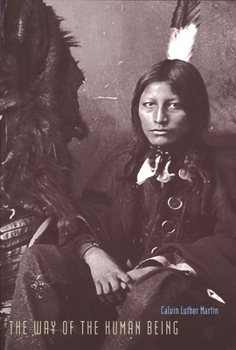
The Way of the Human Being

Select Format
Select Condition 
Book Overview
From Native Americans, Europeans learned about corn and beans, toboggans and canoes, and finding their way around an unfamiliar landscape. Yet the Europeans learned what they wished to learn--not necessarily what the natives actually meant by their stories and their lives--says Calvin Luther Martin in this unique and powerfully insightful book. By focusing on their own questions, Martin observes, those arriving in the New World have failed to grasp the deepest meaning of Native America. Drawing on his own experiences with native people and on their stories, Martin brings us to a new conceptual landscape--the mythworld that seems unfamiliar and strange to those accustomed to western ways of thinking. He shows how native people understand the world and how human beings can and should conduct themselves within it. Taking up the profound philosophical challenge of the Native American "way of the human being," Martin leads us to rethink our entire sense of what is real and how we know the real.
Format:Paperback
Language:English
ISBN:0300085524
ISBN13:9780300085525
Release Date:July 2000
Publisher:Yale University Press
Length:256 Pages
Weight:0.73 lbs.
Dimensions:0.7" x 5.4" x 8.2"
Customer Reviews
2 ratings
surprise surprise
Published by Thriftbooks.com User , 22 years ago
i don't know what i expected when i bought thisbut i know i didn't expect quantum physicsa very nice surpriseinstead of just getting the same old romantic notions of indians as proto-hippies, we get an introduction into some seriously challenging and exciting concepts and experiences of existence and reality
The Way of Courtesy and Trust
Published by Thriftbooks.com User , 26 years ago
Calvin Luther Martin is a non-Native writing about Native American knowledge--a delicate and dicey thing to do, considering that the history of accuracy, respect, understanding and justice is not good. It's essential for non-Natives to read contemporary Native authors, but it's also important for non-Native writers to help other non-Natives build their own bridges of understanding. Martin has lived among Indigenous Americans in the southwest and far north, and learned from them as well as teaching there on subjects as various as quantum physics and alcoholism, in places like a seminary and a prison. He writes well, and often eloquently. A philosophical view builds and winds through the chapters. This is not New Age mush. It is scholarly and personal at the same time. It's intellectually sophisticated, and will bear repeated readings. But it's not obscure. It's down to earth. Martin dares to see that the most advanced quantum view of reality, and the oldest indigenous view of reality are basically the same. He writes movingly of the leap that Einstein and famed ecologist Loren Eiseley couldn't make: that fear creates a fearsome universe, and that compassion, courtesy and trust in relation to all things are the way of the human being in the world. Martin brings together the voices of contemporary American Indians, explorers and ethnologists of past centuries; he weaves threads of Native and non-Native writing. As readers we find not just an important and mind-expanding philosophy beautifully developed, but sharp scenes that inform us on why the pain in Native America persists today--and why that pain is different but real. Martin pulls together ideas that have solid support from others and takes them his own step further. We get some feeling for him as a person, too, a very interesting one, with a wonderful partner. I am grateful to him for this book.
Copyright © 2026 Thriftbooks.com Terms of Use
| Privacy Policy | Do Not
Sell/Share My Personal Information | Cookie Policy | Cookie Preferences | Accessibility Statement
ThriftBooks® and the ThriftBooks® logo are registered trademarks of Thrift Books Global, LLC
ThriftBooks® and the ThriftBooks® logo are registered trademarks of Thrift Books Global, LLC
