


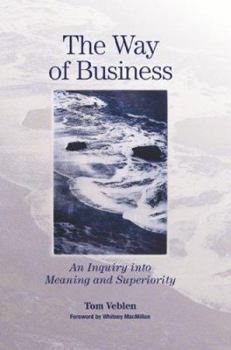
The Way of Business

No Synopsis Available.
Format:Paperback
Language:English
ISBN:0977712109
ISBN13:9780977712106
Release Date:January 2006
Publisher:Veblen
Weight:1.01 lbs.
Customer Reviews
1 rating
Surprise for Both Critics and Partisans of Business
Published by Thriftbooks.com User , 19 years ago
To its critics, business is a greedy, polluting destroyer of livelihoods; to its partisans, an engine of wealth creation, enterprise, and freedom. Both groups will be surprised by Tom Veblen's new book 'The Way of Business'. Veblen identifies the instinct of workmanship -- the urge to 'make things work right around here' -- as the source of the effort to improve business practice. It animates the discovery of new opportunities, the selection of which ones to pursue, and the orchestration of group effort. He sees the business firm as an organic being, constantly evolving, experimenting, and risking its life. The survival of a company, Veblen reminds us, depends on its ability to provide something useful or desirable that compares favorably with alternatives in cost, convenience, and performance. Profit is neither assured nor automatic; it is always contingent. Responding to its social environment is an essential, not an optional element of business enterprise, Veblen says. Any business that ignores this for too long will not be in business for long. In responding to a societal or competitive challenge, business (at its best) takes risks, innovates, invests, improvises, does 'the next best thing', learns from its mistakes, evaluates what works and what doesn't work, and tries again. The difficulty of doing 'the next best thing' where there are no clear guideposts ought to induce a certain humility, or at least some respect for the unknown future. Not knowing what lies ahead doesn't seem to bother the folks who know what's good for all of us, and who never hesitate to substitute dirigiste control for the distributed intelligence of millions of consumer decisions. They think they know exactly the right mix of taxation, public services, and social welfare. Poverty? -- No problem, just use the police power of the state to redistribute money, jobs, government contracts, college admissions, or other goodies to whomever one likes. Sounds great -- until it's put into practice. Whereupon it inevitably devolves into massive corruption, often into civil war, and at best into a system where each form of redistribution lends political legitimacy to the other. That's how the common wealth of nations gets re-allocated toward non- productive ends such as the purchase of poltical favors. The fact is, a national economy is too big and complex to be left to central command. You need distributed intelligence to do the constant fine-tuning that prices (if not subject to cartels, monopolies, oligopolies, corruption, ignorance, politics) provide. Just as a national economy is too big and complex for even the most highly educated bureaucrats to manage, so too is a large multinational corporation. This is where 'The Way of Business' comes in. Its message to business leaders is that distributed intelligence works better than central control. The job of the modern CEO is not to control the company, but to create hundreds or thousands of enterprises within the company t
Copyright © 2026 Thriftbooks.com Terms of Use
| Privacy Policy | Do Not
Sell/Share My Personal Information | Cookie Policy | Cookie Preferences | Accessibility Statement
ThriftBooks® and the ThriftBooks® logo are registered trademarks of Thrift Books Global, LLC
ThriftBooks® and the ThriftBooks® logo are registered trademarks of Thrift Books Global, LLC
