


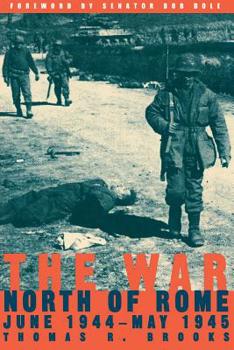
The War North of Rome: June 1944-May 1945


Select Format
Select Condition 
Book Overview
The British had a song for it: "Oh, we are the D-Day Dodgers," based on a comment from a female member of Parliament that dismissed all those not on the beaches at Normandy as draft evaders. Indeed, after the invasion of France the Allied armies in Italy found themselves in a forgotten theater of war. Until now, their eleven-month saga of bitter combat and gallant sacrifice has been ignored.The problem for the Allies was that the fall of the Italian capital on June 4, 1944- although a spectacular public relations triumph- did not end the campaign. The Germans had simply conducted a short strategic withdrawal, conceding one objective while proceeding to fortify additional defense lines.From Salerno to Rome, and most famously at Cassino, the Germans took advantage of the mountains, ridges and rivers that crisscross Italy to exact every drop of blood from the Allied forces. Although the press was no longer paying attention, in the north of Rome the process of continued Allied offensives met by a German resistance that alternated between ferocity and flexibility.A notable feature of the combat in Italy was the large mixture of Allied nationalities involved. Although the American Fifth and the British Eighth Armies were the major forces, on different parts of the line fought South Africans, Canadians, Greeks, Nisei, Jews, Poles, French, Gurkhas, Indians and others. The first U.S. black division fought here, as well as the Brazilian contingent (a curiosity to the Germans, who constantly probed their front).The War North of Rome features a forward by Senator Bob Dole, who fought in this neglected theater of war. He was one of 364 wounded (98 killed) in his regiment's attack on a series of German-held hills. Though he barely survived the battle he states, "I always felt I was fortunate . . ."By the time Allied forces vanquished the enemy in Italy, Russian soldiers were already dancing on Hitler's grave. Nevertheless, our young men north of Rome fought as bravely, and suffered as much, as troops on any front in WWII. Their record of courage and sacrifice is described here in a long-overdue, comprehensive account.
Format:Paperback
Language:English
ISBN:0306812568
ISBN13:9780306812569
Release Date:April 2003
Publisher:Da Capo Press
Length:448 Pages
Weight:1.40 lbs.
Dimensions:1.2" x 6.0" x 9.2"
Customer Reviews
4 ratings
A Great History Effort
Published by Thriftbooks.com User , 18 years ago
A very good work of history research. Off course as couldn't be different it is his point of view but the Author seems tried didn't let scape any important detail on this matter. No book can be complete when we talk about complex subjects like history but there are ones essentials and this certainly are one of them if you want to know and/or study more deeply about Italy Campaign after June, 1944 - one commonly neglected/forgotten aspect of the history of World War II.
Good, but
Published by Thriftbooks.com User , 18 years ago
The War North of Rome offers and excellent review of the movements of Allied combat units in the face of their German nemesis in the last two years of World War II. The book is well written and moves at an enjoyable pace, bridging the strategic and tactical movements with personal accounts of heroism and the struggles of the common Allied soldier slogging through incredibly difficult terrain and a dogged enemy. My criticisms of the book are three-fold. First, the maps provided are very limited. Unless you have a detailed knowledge of the villages, rivers, mountains and highways in Italy, it is very difficult to follow the concise descriptions of troop movements in any meaningful way (the photos provided are generally uninteresting, general and non-descript to the actions taking place). Second, while there are good references to the thoughts and actions of the German commanders, there are no accounts of the common German soldier beyond information passed along from prisoners that the bombings were demoralizing. After all, the conditions including total lack of air support, unbearable and constant shelling, and the effect of constant retreat and death for the Axis are as viable and telling as the impact of weather and constant advance for the allies. I would have liked at least a few personal accounts from the Axis grunts to help balance out the book. Finally, the end is too rushed. The Allies sweep over the Po and the Germans surrender May 2. It would have been interesting to me to see the conditions of surrender and a discussion of those involved especially as fractured units endeavoured to hold on, retreat into Austria, or surrender independently. Overall, this is an excellent military read on a front all too forgotten - its just that is could have been a bit better with another 50 to 100 pages and maps.
Detailed, but.....
Published by Thriftbooks.com User , 19 years ago
This is a welcome book as it covers a neglected campaign, but the book is marred by an impression of sloppiness. If the publishers had provided better maps they might have realized that often left is used when it should be right, east instead of west, an endless series of misstatements geographically. As the book is a compilation of army and divisional histories, it often ignores actions not covered in its sources, creating many disconcerting gaps. For example the 8th Army storms one river line, then the book goes to a chapter or two on the 5th Army, and when it returns to the 8th Army it has advanced unnoticed twenty or thirty miles further. Sometimes it seems if no one cared: in the final chapter half the footnotes disappeared. It's a good book and worth the price, but you cannot help wishing a little more effort had been made: in the end it must be described as the best we are going to get.
Loved it, the real unknown war!!
Published by Thriftbooks.com User , 25 years ago
I read this book while I was living in Italy, so I found it even more interesting. The fall of Rome happened the same time the Invasion of Normandy did, and with the Battles in Western Europe raging on, this arena of combat has allways been overlooked. While few can name any key battles after the fall of Rome, the combat was as heroic and bloody as in any theater. Brooks does an amazing job of recanting this remarkable campaign. The level of detail is superb, and the book was very easy to read. The vast types of units that are described (US Mountain troops, Ethnic units, and varoius allies) makes the book even more enjoyable. This might be a tough book to find, however keep trying, it is well worth it.
Copyright © 2026 Thriftbooks.com Terms of Use
| Privacy Policy | Do Not
Sell/Share My Personal Information | Cookie Policy | Cookie Preferences | Accessibility Statement
ThriftBooks® and the ThriftBooks® logo are registered trademarks of Thrift Books Global, LLC
ThriftBooks® and the ThriftBooks® logo are registered trademarks of Thrift Books Global, LLC
