


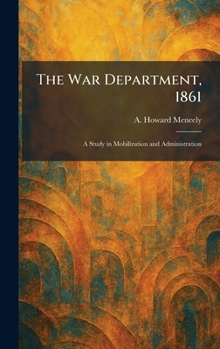
The War Department, 1861: A Study in Mobilization and Administration

Select Format
Select Condition 
Book Overview
"The War Department, 1861: A Study in Mobilization and Administration" is a rigorous historical examination of the institutional and logistical transformation of the United States military during the critical first year of the American Civil War. A. Howard Meneely explores the daunting task of converting a small, fragmented peacetime establishment into a formidable engine for large-scale warfare.
The narrative focuses on the administrative chaos that characterized the early months of the conflict, detailing the tenure of Secretary of War Simon Cameron and the systemic failures that plagued early mobilization efforts. From the procurement of arms and supplies to the integration of state militias into a federal command structure, the book highlights the immense pressure placed upon a department ill-equipped for modern conflict. Meneely provides invaluable insights into the political and bureaucratic maneuvers required to sustain the Union cause.
By analyzing the structural weaknesses and eventual reforms within the War Department, this study illuminates the complexities of military governance and the evolution of American federal power. It remains an essential resource for students of military history, administrative theory, and the political landscape of the 19th-century United States.
This work has been selected by scholars as being culturally important, and is part of the knowledge base of civilization as we know it. This work was reproduced from the original artifact, and remains as true to the original work as possible. Therefore, you may see the original copyright references, library stamps (as most of these works have been housed in our most important libraries around the world), and other notations in the work.
This work is in the public domain in the United States of America, and possibly other nations. Within the United States, you may freely copy and distribute this work, as no entity (individual or corporate) has a copyright on the body of the work.
As a reproduction of a historical artifact, this work may contain missing or blurred pages, poor pictures, errant marks, etc. Scholars believe, and we concur, that this work is important enough to be preserved, reproduced, and made generally available to the public. We appreciate your support of the preservation process, and thank you for being an important part of keeping this knowledge alive and relevant.
Customer Reviews
ThriftBooks ® and the ThriftBooks ® logo are registered trademarks of Thrift Books Global, LLC
