


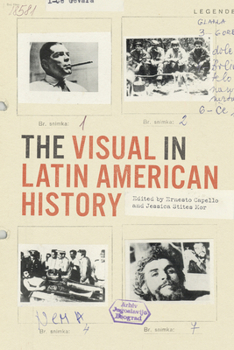
The Visual in Latin American History

A collection of essays examining the role of visual materials in shaping Latin American lives, historical thought, and worldmaking.
Historians have long valued visual media as a source of documentation and illustration. More recently, scholars have also been turning to visual media for another purpose: to directly observe historical processes. Paintings, maps, visual narratives, graffiti, photography--these objects do not simply transmit information about events; they are events. They imbue the historical change we seek to understand.
The Visual in Latin American History is a collection of essays that applies cutting-edge visual-studies methodology to the history of Central and South America and the Caribbean. Contributors focus on the visual production of postcolonial national imaginaries across Latin America--mythologies that purposely omitted Indigenous groups, African diasporic communities, and new migrants from Europe and Asia. The essays range across a vast territory, including erasure in archeology and Afro-Colombian portraiture; image making in domestic spaces and social movements; the visual vocabularies of urban planning and agrarian reform; military "performance" and anti-imperial Cold War exchanges; and humanitarian documentary along the US border.Collectively, the authors show how visual methods can radically transform our understanding of power and culture in Latin America and beyond.
Customer Reviews
ThriftBooks ® and the ThriftBooks ® logo are registered trademarks of Thrift Books Global, LLC
