


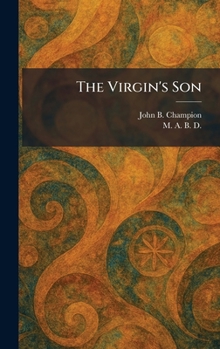
The Virgin's Son

"The Virgin's Son" is a profound theological examination of the doctrine of the Virgin Birth and its essential role within the Christian tradition. Authored by John B. Champion, this work explores the scriptural, historical, and doctrinal foundations of the incarnation of Jesus Christ. Champion provides a rigorous analysis of the biblical accounts, emphasizing the necessity of the miraculous birth in establishing the unique nature and mission of the Savior.
The text addresses the theological implications of Christ's entry into humanity, connecting the Nativity to the broader narrative of redemption and the fulfillment of messianic prophecy. By engaging with both scripture and logic, the author defends the traditional orthodox position, presenting the Virgin Birth not as an isolated event but as a cornerstone of systematic theology and faith. Champion's clear and methodical approach ensures that complex concepts regarding the divinity and humanity of Christ remain accessible to a wide audience.
As a significant contribution to early 20th-century religious literature, "The Virgin's Son" serves as an enduring resource for theologians, students, and readers interested in Christology and New Testament studies. This work stands as a testament to the enduring importance of the Nativity in understanding the person of Jesus Christ.
This work has been selected by scholars as being culturally important, and is part of the knowledge base of civilization as we know it. This work was reproduced from the original artifact, and remains as true to the original work as possible. Therefore, you may see the original copyright references, library stamps (as most of these works have been housed in our most important libraries around the world), and other notations in the work.
This work is in the public domain in the United States of America, and possibly other nations. Within the United States, you may freely copy and distribute this work, as no entity (individual or corporate) has a copyright on the body of the work.
As a reproduction of a historical artifact, this work may contain missing or blurred pages, poor pictures, errant marks, etc. Scholars believe, and we concur, that this work is important enough to be preserved, reproduced, and made generally available to the public. We appreciate your support of the preservation process, and thank you for being an important part of keeping this knowledge alive and relevant.
Customer Reviews
ThriftBooks ® and the ThriftBooks ® logo are registered trademarks of Thrift Books Global, LLC
