


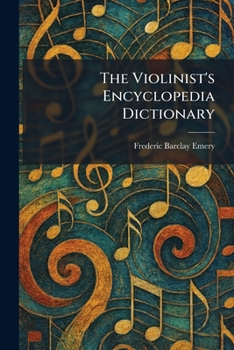
The Violinist's Encyclopedia Dictionary

"The Violinist's Encyclopedia Dictionary" is a comprehensive reference work dedicated to the world of the violin and its players. This essential volume serves as an exhaustive guide to the terminology, techniques, and historical figures that have shaped the art of violin playing. Written with meticulous detail, the book covers a vast array of topics, including the construction of the instrument, biographical sketches of renowned violinists and composers, and definitions of musical terms specific to string performance.
Whether exploring the intricacies of bow technique or the evolution of violin literature, readers will find a wealth of information curated to enhance their understanding of the instrument. "The Violinist's Encyclopedia Dictionary" remains a valuable resource for students, teachers, and professional musicians seeking a deeper knowledge of the technical and aesthetic aspects of their craft. Its alphabetical arrangement allows for quick consultation, making it an indispensable companion for anyone devoted to the study of the violin. This work highlights the rich heritage of string music and provides a foundational look at the cultural and technical milestones of the early 20th-century musical landscape.
This work has been selected by scholars as being culturally important, and is part of the knowledge base of civilization as we know it. This work was reproduced from the original artifact, and remains as true to the original work as possible. Therefore, you may see the original copyright references, library stamps (as most of these works have been housed in our most important libraries around the world), and other notations in the work.
This work is in the public domain in the United States of America, and possibly other nations. Within the United States, you may freely copy and distribute this work, as no entity (individual or corporate) has a copyright on the body of the work.
As a reproduction of a historical artifact, this work may contain missing or blurred pages, poor pictures, errant marks, etc. Scholars believe, and we concur, that this work is important enough to be preserved, reproduced, and made generally available to the public. We appreciate your support of the preservation process, and thank you for being an important part of keeping this knowledge alive and relevant.
Customer Reviews
ThriftBooks ® and the ThriftBooks ® logo are registered trademarks of Thrift Books Global, LLC
