


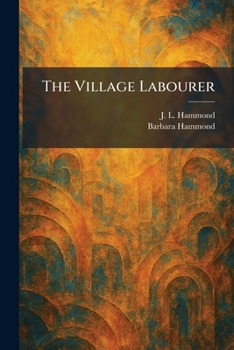
The Village Labourer

"The Village Labourer 1760-1832" is a seminal study of the social and economic transformation of rural England during the pivotal decades of the Industrial Revolution. Authors J.L. Hammond and Barbara Hammond provide a detailed examination of the impact of the enclosure movement on the English peasantry, illustrating how the loss of common land rights fundamentally altered the lives of the working class. Through meticulous research, the work explores the systemic shift from a traditional village economy to a more rigid agricultural capitalist system.
This influential historical account highlights the struggles of the rural poor, documenting their resistance and the subsequent legislative responses that shaped the social fabric of the nation. The authors focus on the human experience of the agricultural worker, shedding light on the harsh realities of poverty, the breakdown of communal ties, and the emergence of new social hierarchies. As a cornerstone of social history, "The Village Labourer 1760-1832" remains an essential resource for understanding the roots of modern British society and the profound consequences of economic modernization on the common people. Its insightful analysis of land reform and labor relations continues to resonate with students of history and sociology alike.
This work has been selected by scholars as being culturally important, and is part of the knowledge base of civilization as we know it. This work was reproduced from the original artifact, and remains as true to the original work as possible. Therefore, you may see the original copyright references, library stamps (as most of these works have been housed in our most important libraries around the world), and other notations in the work.
This work is in the public domain in the United States of America, and possibly other nations. Within the United States, you may freely copy and distribute this work, as no entity (individual or corporate) has a copyright on the body of the work.
As a reproduction of a historical artifact, this work may contain missing or blurred pages, poor pictures, errant marks, etc. Scholars believe, and we concur, that this work is important enough to be preserved, reproduced, and made generally available to the public. We appreciate your support of the preservation process, and thank you for being an important part of keeping this knowledge alive and relevant.
Customer Reviews
ThriftBooks ® and the ThriftBooks ® logo are registered trademarks of Thrift Books Global, LLC
