


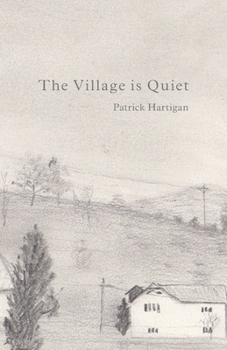
The Village is Quiet

The Village is Quiet is Patrick Hartigan's second book - a collection of forty-two titled vignettes drawn from twenty years of visits to the Slovak village where his wife Lenka was born. Begun in 2002 and first presented as a multimedia work of paintings, films and short stories in 2009, the book gathers Hartigan's notebook observations into a portrait of a place and a family unlike any in contemporary Australian literature.
The village has a public announcement system left over from the Socialist era, still broadcasting deaths and the price of Polish vegetables. Grandpa tends his goats - each with a name - repairs fences with recycled wire, and reads the racing guide aloud to whoever happens to be in the kitchen. Grandma hides advertising catalogues so grandpa won't spend the afternoon marvelling at the photographs of swimming pools. A deaf goatherd feeds fresh bread rolls to the fish in the creek. A Roma man named Jano - who has worked for grandma for twenty years - has only one word for wealthy countries like Australia: bizniss, delivered with a hand spiralling downwards like a corkscrew.
Hartigan writes from the precise position of the affectionate outsider: linguistically adrift, endlessly observant, reaching for his notebook and charcoal pencil when words run out. The vignettes accumulate like a sketchbook - in the way that grandma's kitchen inventory (radio, shot glasses, lolly wrappers, broken pens, more wire) builds across multiple pieces into something close to a complete world. As grandpa ages, slows, and finally passes, the book becomes an elegy - for a man, a way of life, and a village where the disco across the creek still draws a Saturday night crowd who walk to church Sunday morning with their heads down.
Published by Gazebo Books in 2021, The Village is Quiet is a rare document of rural Central European life told through the quiet, sustained attention of a painter's eye.
Customer Reviews
ThriftBooks ® and the ThriftBooks ® logo are registered trademarks of Thrift Books Global, LLC
