


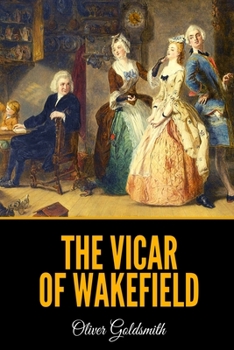
The Vicar of Wakefield: A Tale, Supposed to be written by Himself


Select Format
Select Condition 
Book Overview
I was ever of opinion, that the honest man who married and brought up a large family, did more service than he who continued single, and only talked of population. From this motive, I had scarce taken orders a year before I began to think seriously of matrimony, and chose my wife as she did her wedding gown, not for a fine glossy surfaces but such qualities as would wear well. To do her justice, she was a good-natured notable woman; and as for breeding, there were few country ladies who could shew more. She could read any English book without much spelling, but for pickling, preserving, and cookery, none could excel her. She prided herself also upon being an excellent contriver in house-keeping; tho' I could never find that we grew richer with all her contrivances. However, we loved each other tenderly, and our fondness encreased as we grew old. There was in fact nothing that could make us angry with the world or each other. We had an elegant house, situated in a fine country, and a good neighbourhood. The year was spent in moral or rural amusements; in visiting our rich neighbours, and relieving such as were poor. We had no revolutions to fear, nor fatigues to undergo; all our adventures were by the fire-side, and all our migrations from the blue bed to the brown. As we lived near the road, we often had the traveller or stranger visit us to taste our gooseberry wine, for which we had great reputation; and I profess with the veracity of an historian, that I never knew one of them find fault with it. Our cousins too, even to the fortieth remove, all remembered their affinity, without any help from the Herald's office, and came very frequently to see us. Some of them did us no great honour by these claims of kindred; as we had the blind, the maimed, and the halt amongst the number. However, my wife always insisted that as they were the same flesh and blood, they should sit with us at the same table. So that if we had not, very rich, we generally had very happy friends about us; for this remark will hold good thro' life, that the poorer the guest, the better pleased he ever is with being treated: and as some men gaze with admiration at the colours of a tulip, or the wing of a butterfly, so I was by nature an admirer of happy human faces. However, when any one of our relations was found to be a person of very bad character, a troublesome guest, or one we desired to get rid of, upon his leaving my house, I ever took care to lend him a riding coat, or a pair of boots, or sometimes an horse of small value, and I always had the satisfaction of finding he never came back to return them. By this the house was cleared of such as we did not like; but never was the family of Wakefield known to turn the traveller or the poor dependent out of doors. Thus we lived several years in a state of much happiness, not but that we sometimes had those little rubs which Providence sends to enhance the value of its favours. - Taken from "The Vicar of Wakefield" written by Oliver Goldsmith
Format:Paperback
Language:English
ISBN:1660857422
ISBN13:9781660857425
Release Date:January 2020
Publisher:Independently Published
Length:130 Pages
Weight:0.44 lbs.
Dimensions:0.3" x 6.0" x 9.0"
Customer Reviews
5 ratings
A billiant novel written by a brilliant man!
Published by Thriftbooks.com User , 21 years ago
Although Goldsmith was brilliant, he was not an easy man to know and to like, and his egoism and unevenness of character does come out in this book. He was always misunderstood, as geniuses often are. This book has assured Goldsmith a place high up in the literature food chain. The theme of the book resembles somewhat the Book of Job from The Bible. Our hero is a good and innocent man who remains steadfast in faith and unbroken in courage as he faces numerous disasters. It is a story about the family Primrose and its fall from it's a place of comfort and security. The family consists of a mother and father and six children. Mr. Goldsmith's genius is in characterization, as well as his ability to evoke a pure goodness of heart and warmth and generosity of people of simple faith and warm generosity. This little book is truly a masterpiece.
loverly story
Published by Thriftbooks.com User , 22 years ago
i found the book in a car boot sale it is over a hundred years old ,it was a bit hard with the text,being old ,i had to read the book twice for it to sink in ,what a story best one yet,especialy that it was written so long ago,i havent read the new version, but if its like mine you will enjoy it happy reading .
A thoroughly good read that still has relevance today.
Published by Thriftbooks.com User , 24 years ago
"Conscience is a coward, and those faults it has not strength enough to prevent, it seldom has justice enough to accuse." So ends chapter 13 in this delightful novel by Oliver Goldsmith, his only novel by the way.Oliver creates a pious character in the form of the vicar, Dr Primrose, that suffers from that most deadly of the 7 deadly sins, Pride. The problem is he doesn't know it. As a result he is brought down peg by peg, and made a thorough fool of in the process, in a way that is comical and warm to the reader. The vicar becomes a most beloved character by way of his suffering and in the end I'm sure will have earned from even the most hard hearted reader that most cherished gift a reader can bestow upon any flawed character, redemption.Oliver also creates villiany, more like evil incarnate, in the form of Mr. Thornhill. Thornhill is central to the most severe of the hardships suffered by the vicar and his family. A very meddlesome and self-centered character indeed!!Written in the 1750's, it has it all. Greed,envy,lust,unjust imprisonment, even prostitution. Yes, It's hard to believe a novel written in the 1750's could even touch on the subject, but nevertheless it is central to the plot. Combine all this with some of the finest wit in English literature and you've got a great way to spend a weekend. The book is less than 200 pages and moves along at nice pace from page one. Well worth everyone's time.
The Consolations of Philosophy and Religion
Published by Thriftbooks.com User , 26 years ago
Oliver Goldsmith's 1766 novel, "The Vicar of Wakefield" offers the trials and tribulations of Primrose, an ecclesiastic living in the English countryside. Primrose is content in his life, with a faithful wife, and lovely, if somewhat distracted children. Hearing that his banker has gotten into trouble and fled the country, Primrose and his family begin a series of adventures which test the strength of Primrose's convictions.Among the issues which Goldsmith addresses in the novel are social ambition in a rigid class system, the drawbacks and benefits of a relatively liberal household, and the admittedly imperfect nature of the British legal system. Sprinkled throughout the novel are various discourses on the notion of liberty, the primacy of the monarchy, and a wealth of interesting references to British imperialism and colonial slavery. Regarding the class system, Primrose seems throughout the novel, to eschew the idea that social or economic mobility is possible, or even desirable. He posits, in a way that follows Aristotle and Edmund Burke, that people are fit for certain stations by their very nature; and that such social partitioning is right and should be maintained. Primrose also appears as a latter day Horace, championing the virtues of simple, rustic life. This pastoral life is directly associated in the novel with the laboring classes, who, not without faults themselves, manage to avoid the intrigues and excesses of the consistently vilified city folk.Goldsmith's writing style is fast-paced, with clear, direct language, wonderfully rendered characters, and a surprising number of plot twists for so short a work. Primrose and his eldest son George are the two finest characters in the novel. Both exhibit a picaresque tendency to wander and interact - Primrose with the intellectual/philosophical elements, and George with the material/experiential elements in the world. This is altogether a wonderful, spirited novel, and Stephen Coote's introduction to this Penguin edition is excellent in its explication of the novel's major themes and concerns.
An intelligent book
Published by Thriftbooks.com User , 26 years ago
I liked this book, but did not get all five stars because of the slowness and somewhat predictable ending. But it was good writing, despite being a little bit stereotypical, but here i am chastizing a book which i gave four stars.
Copyright © 2026 Thriftbooks.com
Terms of Use | Privacy Policy | Do Not Sell/Share My Personal Information | Cookie Notice | Cookie Preferences | Accessibility Statement
ThriftBooks ® and the ThriftBooks ® logo are registered trademarks of Thrift Books Global, LLC
ThriftBooks ® and the ThriftBooks ® logo are registered trademarks of Thrift Books Global, LLC
