


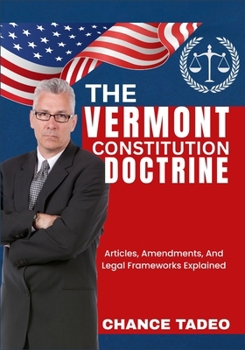
The Vermont Constitution Doctrine: Articles, Amendments, And Legal Frameworks Explained
No Customer Reviews

The Vermont Constitution stands as one of the most remarkable and enduring state constitutions in American history. Adopted in 1777-before Vermont even became a state of the Union-it reflects a bold, independent spirit rooted in democratic ideals, revolutionary fervor, and an unwavering commitment to individual liberty, civic virtue, and the rule of law. As the first written constitution in North America to prohibit slavery, guarantee universal male suffrage without property ownership, and articulate a bill of rights, Vermont's foundational document was truly ahead of its time. It laid down principles that would influence broader constitutional developments in the United States and beyond.
The Vermont Constitution of 1777 was amended in 1786 and again significantly revised in 1793-the version that serves as the current foundational document, albeit through regular modern amendments. Despite numerous revisions and updates over the centuries, the core principles enshrined in the original text have remained largely intact: equality before the law, the right to due process, the importance of civic responsibility, and the separation of powers.
Among its most revolutionary features were:
- Outlawing Slavery: Vermont was the first territory in what would become the United States to abolish slavery outright in its constitution, a full 89 years before the Thirteenth Amendment to the U.S. Constitution.
- Universal Male Suffrage: Unlike most other states that limited voting rights to property-owning males, Vermont granted the right to vote to all free adult men, a progressive stance that expanded democratic participation.
- Education and the Common Good: The constitution emphasized the importance of education for preserving liberty and good government, mandating support for public schooling.
- Religious Freedom: It guaranteed freedom of religion while recognizing the importance of morality and virtue derived from religious principles in sustaining a free society.
Throughout Vermont's history, the constitution has served as both a guardian of liberty and a flexible instrument of governance, enabling the people of Vermont to adapt their government to changing times without abandoning foundational ideals. Amendments over the centuries have addressed issues ranging from the organization of the judiciary to modern civil rights protections, including gender equality and same-sex marriage.
In today's context, the Vermont Constitution remains a living document-one that continues to evolve through a deliberate and thoughtful amendment process that requires action by two separately elected legislatures and approval by the people. This process ensures both stability and responsiveness, anchoring the state's legal order in the will of its citizens while preventing hasty or reactionary changes.
This book seeks to provide a comprehensive examination of the Vermont Constitution in historical, legal, and political context. We will trace its origins, dissect its structure and key provisions, explore landmark amendments and interpretations, and reflect on its enduring legacy. Whether viewed through the lens of constitutional law, civic identity, or democratic innovation, the Vermont Constitution stands as a vital expression of self-government-one that speaks not only to the people of Vermont but also to the broader American constitutional tradition.
As we delve into its articles, principles, and real-world applications, it becomes clear that the Vermont Constitution is not just a historical artifact. It is a testament to the possibilities of grassroots democracy, a mirror of the values of its people, and a compelling example of constitutional resilience in a rapidly changing world.
The Vermont Constitution of 1777 was amended in 1786 and again significantly revised in 1793-the version that serves as the current foundational document, albeit through regular modern amendments. Despite numerous revisions and updates over the centuries, the core principles enshrined in the original text have remained largely intact: equality before the law, the right to due process, the importance of civic responsibility, and the separation of powers.
Among its most revolutionary features were:
- Outlawing Slavery: Vermont was the first territory in what would become the United States to abolish slavery outright in its constitution, a full 89 years before the Thirteenth Amendment to the U.S. Constitution.
- Universal Male Suffrage: Unlike most other states that limited voting rights to property-owning males, Vermont granted the right to vote to all free adult men, a progressive stance that expanded democratic participation.
- Education and the Common Good: The constitution emphasized the importance of education for preserving liberty and good government, mandating support for public schooling.
- Religious Freedom: It guaranteed freedom of religion while recognizing the importance of morality and virtue derived from religious principles in sustaining a free society.
Throughout Vermont's history, the constitution has served as both a guardian of liberty and a flexible instrument of governance, enabling the people of Vermont to adapt their government to changing times without abandoning foundational ideals. Amendments over the centuries have addressed issues ranging from the organization of the judiciary to modern civil rights protections, including gender equality and same-sex marriage.
In today's context, the Vermont Constitution remains a living document-one that continues to evolve through a deliberate and thoughtful amendment process that requires action by two separately elected legislatures and approval by the people. This process ensures both stability and responsiveness, anchoring the state's legal order in the will of its citizens while preventing hasty or reactionary changes.
This book seeks to provide a comprehensive examination of the Vermont Constitution in historical, legal, and political context. We will trace its origins, dissect its structure and key provisions, explore landmark amendments and interpretations, and reflect on its enduring legacy. Whether viewed through the lens of constitutional law, civic identity, or democratic innovation, the Vermont Constitution stands as a vital expression of self-government-one that speaks not only to the people of Vermont but also to the broader American constitutional tradition.
As we delve into its articles, principles, and real-world applications, it becomes clear that the Vermont Constitution is not just a historical artifact. It is a testament to the possibilities of grassroots democracy, a mirror of the values of its people, and a compelling example of constitutional resilience in a rapidly changing world.
Format:Paperback
Language:English
ISBN:B0FM3KTF73
ISBN13:9798297512276
Release Date:August 2025
Publisher:Independently Published
Length:216 Pages
Weight:0.84 lbs.
Dimensions:0.5" x 7.0" x 10.0"
Customer Reviews
0 rating
Copyright © 2026 Thriftbooks.com
Terms of Use | Privacy Policy | Do Not Sell/Share My Personal Information | Cookie Policy | Cookie Preferences | Accessibility Statement
ThriftBooks ® and the ThriftBooks ® logo are registered trademarks of Thrift Books Global, LLC
ThriftBooks ® and the ThriftBooks ® logo are registered trademarks of Thrift Books Global, LLC
