


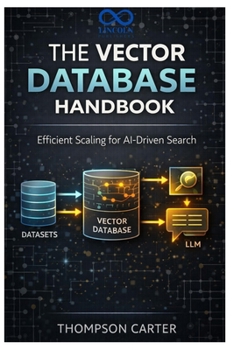
The Vector Database Handbook: Efficient Scaling for AI-Driven Search

Traditional databases store data. Vector databases understand it.
Semantic search, recommendations, and AI-powered retrieval systems all rely on vector databases. This book provides a clear, beginner-friendly introduction to vector databases and shows how tools like Pinecone, Milvus, and Weaviate power modern AI applications.
If you want to build systems that search by meaning instead of keywords, this book is your starting point.
What You'll Learn in This Book
What vector databases are and why they matter
How embeddings enable semantic search
Core concepts behind similarity search
Practical use cases for AI and LLM applications
How Pinecone, Milvus, and Weaviate compare
When to use managed vs. self-hosted solutions
Designing scalable retrieval systems for real projects
No prior experience with vector databases is required.
Who This Book Is For
This guide is ideal for:
Beginners in AI and machine learning
Software developers and data engineers
Developers building LLM-powered applications
Data scientists exploring semantic search
Startup founders and product builders
Basic programming knowledge is helpful but not required.
Why Vector Databases Matter
Keyword search breaks down when data grows complex.
Vector databases enable systems to:
Search by meaning and context
Power retrieval-augmented generation (RAG)
Scale AI-driven recommendations
Handle unstructured data efficiently
This book explains these ideas clearly, practically, and without unnecessary math.
Customer Reviews
ThriftBooks® and the ThriftBooks® logo are registered trademarks of Thrift Books Global, LLC
