


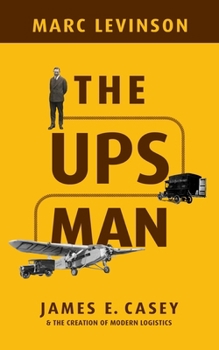
The Ups Man: James E. Casey and the Creation of Modern Logistics
No Customer Reviews

How a little-known executive revolutionized the delivery business
James E. Casey was a most improbable revolutionary. Shy and soft-spoken, in his day he was all but unknown to the public at large. Drawing little attention to himself, he laid the foundation of an industry that is fundamental to the modern world economy--the industry that manages businesses' long-distance supply chains and allows consumers to obtain almost anything from anywhere with just a credit card and a couple of days' patience. In The UPS Man, Marc Levinson provides the first-ever biography of the self-taught executive who started a bicycle messenger service in 1907 and built it into a giant of modern logistics. Casey was associated with United Parcel Service for seventy-six years, introducing innovation after innovation into the stodgiest of industries as UPS conquered the retail delivery market, then reshaped itself into the first company able to collect packages from hundreds of thousands of senders and deliver them when promised to recipients far away, and then changed itself yet again to move parcels around the globe. That more than three hundred thousand packages are delivered somewhere in the world every minute of every day is a monument to Casey's accomplishments. While Casey was an inspiring leader, he was also a ferocious competitor and a demanding boss. Under his leadership, UPS frequently acted in ways that it prefers not to include in its corporate mythology. Some of these actions were dubious. Others were flat-out illegal. Certainly some of these actions might not make current employees proud, yet were indispensable to UPS's emergence as a powerful force in freight transportation. Drawing on previously neglected sources, The UPS Man offers a nuanced portrait of an entrepreneur and executive whose obsession with small parcels still affects our lives today.Format:Hardcover
Language:English
ISBN:1479848387
ISBN13:9781479848386
Release Date:October 2026
Publisher:New York University Press
Length:352 Pages
Customer Reviews
0 rating
Copyright © 2026 Thriftbooks.com
Terms of Use | Privacy Policy | Do Not Sell/Share My Personal Information | Cookie Policy | Cookie Preferences | Accessibility Statement
ThriftBooks ® and the ThriftBooks ® logo are registered trademarks of Thrift Books Global, LLC
ThriftBooks ® and the ThriftBooks ® logo are registered trademarks of Thrift Books Global, LLC
