


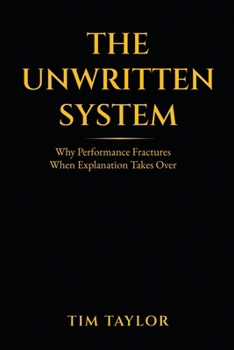
The Unwritten System

Select Format
Select Condition 
Book Overview
Across disciplines and levels, performance fails in remarkably consistent ways under pressure. Execution collapses even when preparation is sound, skill is proven, and experience is deep. These failures are routinely explained using familiar language-confidence, focus, mindset, nerves-terms that describe how breakdown feels without explaining why it occurs.
The Unwritten System offers a structural account of performance failure and stability. Rather than treating breakdown as a psychological or motivational problem, the book examines performance as an organised system governed by access, timing, and permission-mechanisms that change predictably when conditions intensify.
Drawing on decades of observation across high-stakes performance environments, the book explains why repetition stops transferring to competition, why technically capable performers fragment under pressure, and why traditional training and psychological models fail to protect execution when consequence becomes real. It identifies a missing structural layer beneath technique, physiology, and psychology-one that has shaped outcomes for generations but has rarely been named.
This is not a training manual, a self-help book, or a collection of techniques. It does not offer drills or prescriptions. Its purpose is diagnostic: to make visible the system that governs whether performance remains accessible when pressure, speed, fatigue, and visibility increase.
Written for serious athletes, coaches, performance professionals, and decision-makers operating in high-responsibility environments, The Unwritten System stands as a foundational work. It can be read independently, but also functions as the architectural core of a wider body of work examining performance under exposure.
Customer Reviews
ThriftBooks® and the ThriftBooks® logo are registered trademarks of Thrift Books Global, LLC
