


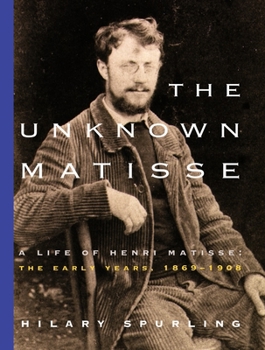
The Unknown Matisse: A Life of Henri Matisse: The Early Years, 1869-1908
(Book #1 in the Matisse Series)


Select Format
Select Condition 
Book Overview
Henri Matisse is one of the masters of twentieth-century art and a household word to millions of people who find joy and meaning in his light-filled, colorful images--yet, despite all the books devoted to his work, the man himself has remained a mystery. Now, in the hands of the superb biographer Hilary Spurling, the unknown Matisse becomes visible at last. Matisse was born into a family of shopkeepers in 1869, in a gloomy textile town in the north of France. His environment was brightened only by the sumptuous fabrics produced by the local weavers--magnificent brocades and silks that offered Matisse his first vision of light and color, and which later became a familiar motif in his paintings. He did not find his artistic vocation until after leaving school, when he struggled for years with his father, who wanted him to take over the family seed-store. Escaping to Paris, where he was scorned by the French art establishment, Matisse lived for fifteen years in great poverty--an ordeal he shared with other young artists and with Camille Joblaud, the mother of his daughter, Marguerite. But Matisse never gave up. Painting by painting, he struggled toward the revelation that beckoned to him, learning about color, light, and form from such mentors as Signac, Pissarro, and the Australian painter John Peter Russell, who ruled his own art colony on an island off the coast of Brittany. In 1898, after a dramatic parting from Joblaud, Matisse met and married Am lie Parayre, who became his staunchest ally. She and their two sons, Jean and Pierre, formed with Marguerite his indispensable intimate circle. From the first day of his wedding trip to Ajaccio in Corsica, Matisse realized that he had found his spiritual home: the south, with its heat, color, and clear light. For years he worked unceasingly toward the style by which we know him now. But in 1902, just as he was on the point of achieving his goals as a painter, he suddenly left Paris with his family for the hometown he detested, and returned to the somber, muted palette he had so recently discarded. Why did this happen? Art historians have called this regression Matisse's "dark period," but none have ever guessed the reason for it. What Hilary Spurling has uncovered is nothing less than the involvement of Matisse's in-laws, the Parayres, in a monumental scandal which threatened to topple the banking system and government of France. The authorities, reeling from the divisive Dreyfus case, smoothed over the so-called Humbert Affair, and did it so well that the story of this twenty-year scam--and the humiliation and ruin its climax brought down on the unsuspecting Matisse and his family--have been erased from memory until now. It took many months for Matisse to come to terms with this disgrace, and nearly as long to return to the bold course he had been pursuing before the interruption. What lay ahead were the summers in St-Tropez and Collioure; the outpouring of "Fauve" paintings; Matisse's experiments with sculpture; and the beginnings of acceptance by dealers and collectors, which, by 1908, put his life on a more secure footing. Hilary Spurling's discovery of the Humbert Affair and its effects on Matisse's health and work is an extraordinary revelation, but it is only one aspect of her achievement. She enters into Matisse's struggle for expression and his tenacious progress from his northern origins to the life-giving light of the Mediterranean with rare sensitivity. She brings to her task an astonishing breadth of knowledge about his family, about fin-de-si cle Paris, the conventional Salon painters who shut their doors on him, his artistic comrades, his early patrons, and his incipient rivalry with Picasso. In Hilary Spurling, Matisse has found a biographer with a detective's ability to unearth crucial facts, the narrative power of a novelist, and profound empathy for her subject.
Format:Paperback
Language:English
ISBN:0375711333
ISBN13:9780375711336
Release Date:October 2005
Publisher:Knopf Publishing Group
Length:512 Pages
Weight:2.15 lbs.
Dimensions:1.5" x 7.0" x 9.2"
Customer Reviews
4 ratings
Matisse's Colors
Published by Thriftbooks.com User , 24 years ago
This is a genuinely inspiring biography, clearly written and deeply felt, powerfully communicating the revolutionary ideas of what painting could and should be that drove, and were driven by, Henri Matisse. Spurling vividly describes Matisse's struggles to balance his need to paint with financial reality and his society's disdain, often using the artist's own letters and recollections to depict his growing obsession with color and impatience with representation.Although I eagerly await the second volume, the true measure of Spurling's success is my anticipation in revisiting Matisse's paintings -- my enjoyment of his work has been increased immeasurably by reading this book.
Best art biography I've read
Published by Thriftbooks.com User , 26 years ago
What a book. Spurling writes a complete biography of Matisse, looking not just at his art and artisitc influences but at his entire life. Unlike Richardson in his biographies of Picasso, Spurling never stoops to cheerleading or excuse-making. (However, seeing as Spurling's book was written years after Richardson's first two Picasso volumes, I can't help but wonder how the two writers portray the Steins so differently. I wish Spurling had been willing to take on Richardson a bit more directly.) Instead she explains and enlightens. The pace of the text is perfect. Of particular fascination is Spurling's accounts of Matisse's artistic breakthrough, starting in the Fauve summer in 1905. This book is exciting, breath-taking, insightful and I can't wait for volume two. Quite possibly the best book I read in 1999.
Moves beyond scholarship into a compassionate, human study
Published by Thriftbooks.com User , 27 years ago
THE UNKNOWN MATISSE is an exceptional biography. Moving beyond historical fact, Spurling sensitively imagines the human dimension of Matisse's life. She weaves historical detail, Matisse's writings and the writings of other artists, critics, conversations, all kinds of information into a seamless whole, ultimately bringing insight and understanding to his life's work. It's one of the rare biographies where the reader can feel "inside" along with the subject. I loved it. It's a wonderful book..
A continuously enthralling and insightful biography
Published by Thriftbooks.com User , 27 years ago
This account of the life of Matisse up until the age of 40 is a revelation. His early years in the dour industrial flatlands of northern France, the intensity of his struggle to find his own true artistic vision, the long years of poverty amd of sometimes crippling insecurity - all are described with sensitivity and narrative drive. Spurling's account of how the Humbert affair nearly destroyed Matisse is a triumph of historical detective work. And, set against all his trials, she movingly depicts the love and strength he derived from his marriage to Amelie. Finally, right at the end, we are in Paris in the first decade of the 20th century, when Matisse and Picasso between them revolutionized western art. It doesn't get any better than this.
Copyright © 2026 Thriftbooks.com
Terms of Use | Privacy Policy | Do Not Sell/Share My Personal Information | Cookie Policy | Cookie Preferences | Accessibility Statement
ThriftBooks ® and the ThriftBooks ® logo are registered trademarks of Thrift Books Global, LLC
ThriftBooks ® and the ThriftBooks ® logo are registered trademarks of Thrift Books Global, LLC
