


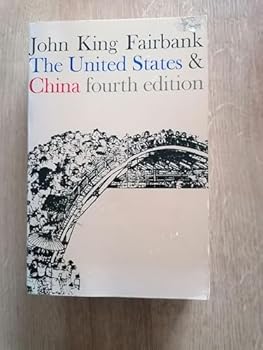
The United States and China: Fourth edition (American Foreign Policy Library)


Select Format
Select Condition 
Book Overview
For two generations scholars and general readers have looked to John King Fairbank for knowledge and insights about China. In three editions of The United States and China he has provided these. In this fourth edition, enlarged, he includes a new Preface and an Epilogue that brings the book up to date through the events of 1982. He has also updated the vast bibliography and both indexes. This book stands almost alone as a history of China, an analysis of Chinese society, and an account of Sino-American relations, all in brief compass. The older portions of the book still sparkle, and they have been refined by the latest scholarship and the author's own observations in the People's Republic of China. And many photographs, especially chosen by John and Wilma Fairbank, show a changing land and its inhabitants.
Format:Paperback
Language:English
ISBN:0674924363
ISBN13:9780674924369
Release Date:March 1979
Publisher:Harvard University Press
Length:630 Pages
Weight:1.60 lbs.
Customer Reviews
2 ratings
International Relations, Sweet and Sour
Published by Thriftbooks.com User , 21 years ago
In an era where America is the last remaining superpower, it is sometimes easy to feel that there are no real threats left in the world to American security (apart from the occasional terrorist, that is); it is easy to slip into a complacency a la the British Empire in thinking itself impregnable due to its relative insularity from the rest of the world (truly, for a variety of reasons, Canada and Mexico pose no real threats to America) and the power it is able to wield abroad. Of course, there are many countries, geographic areas, economic coalitions, and military alliances in the world, both real and potential, that could pose a major threat to the America. Thus, it is important that in this period of relative hegemonic success, Americans do not become insular in thinking. This is a rather long preamble to introduce a book of importance, 'The United States and China', by John King Fairbank. When I first studied political science as an undergraduate, I had completed the requirements for my primary major without having once heard a lecture or participated in a discussion of any substance on the topic of China. Perhaps this is because the prominence of the Soviet Union in the superpower relations, and most political scientists when discussing international relations preferred to focus on economic powers (Japan, Western Europe, emerging markets and resource-rich areas), or on comparative democracies, both of which do not include China. China has been, and continues to be, a mystery in most Western eyes, including those of scholars and political strategists. It has only been with the breakup of the Soviet Union that the prominence of China has been increased. No longer is it considered a backwater; no longer is it ignored save in relation to American interests in Taiwan. Even at the height of the conflicts in Vietnam and Korea, the West had very limited knowledge of China. As mysteriously enigmatic as the Soviet Union might have been, it was still essentially Western in orientation and ambition; the Western powers could be reasonable sure that discussions with and strategies against the Soviet Union would proceed on the same framework of thought. Despite China now being a Marxist-inspired regime, it is still essentially Eastern, with an historical and philosophical underpinning vastly different from the West. China is one of few civilisations to survive that arose as an independent urban culture from the mists of prehistory; it is the only one that has retained a powerful position. Due to it's relative isolation from the rest of the world, and its now millennium-old concentration on the preservation of cultural integrity against outside forces (which produces a very strange dynamic with the introduction of Marxist and Western radical political ideas), China has remained focussed upon internal situations. 'The strength of China's age-old family system has made it a target of the modern revolution. New loyalties to nation and to party have counter
International relations, sweet and sour
Published by Thriftbooks.com User , 22 years ago
In an era where America is the last remaining superpower, it is sometimes easy to feel that there are no real threats left in the world to American security (apart from the occasional terrorist, that is); it is easy to slip into a complacency a la the British Empire in thinking itself impregnable due to its relative insularity from the rest of the world (truly, for a variety of reasons, Canada and Mexico pose no real threats to America) and the power it is able to wield abroad. Of course, there are many countries, geographic areas, economic coalitions, and military alliances in the world, both real and potential, that could pose a major threat to the America. Thus, it is important that in this period of relative hegemonic success, Americans do not become insular in thinking.This is a rather long preamble to introduce a book of importance, 'The United States and China', by John King Fairbank. When I first studied political science as an undergraduate, I had completed the requirements for my primary major without having once heard a lecture or participated in a discussion of any substance on the topic of China. Perhaps this is because the prominence of the Soviet Union in the superpower relations, and most political scientists when discussing international relations preferred to focus on economic powers (Japan, Western Europe, emerging markets and resource-rich areas), or on comparative democracies, both of which do not include China. China has been, and continues to be, a mystery in most Western eyes, including those of scholars and political strategists.It has only been with the breakup of the Soviet Union that the prominence of China has been increased. No longer is it considered a backwater; no longer is it ignored save in relation to American interests in Taiwan. Even at the height of the conflicts in Vietnam and Korea, the West had very limited knowledge of China. As mysteriously enigmatic as the Soviet Union might have been, it was still essentially Western in orientation and ambition; the Western powers could be reasonable sure that discussions with and strategies against the Soviet Union would proceed on the same framework of thought. Despite China now being a Marxist-inspired regime, it is still essentially Eastern, with an historical and philosophical underpinning vastly different from the West. China is one of few civilisations to survive that arose as an independent urban culture from the mists of prehistory; it is the only one that has retained a powerful position. Due to it's relative isolation from the rest of the world, and its now millennium-old concentration on the preservation of cultural integrity against outside forces (which produces a very strange dynamic with the introduction of Marxist and Western radical political ideas), China has remained focussed upon internal situations. 'The strength of China's age-old family system has made it a target of the modern revolution. New loyalties to nation and to party have countered the
Copyright © 2026 Thriftbooks.com Terms of Use
| Privacy Policy | Do Not
Sell/Share My Personal Information | Cookie Policy | Cookie Preferences | Accessibility Statement
ThriftBooks® and the ThriftBooks® logo are registered trademarks of Thrift Books Global, LLC
ThriftBooks® and the ThriftBooks® logo are registered trademarks of Thrift Books Global, LLC
