


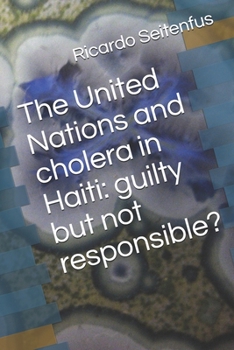
The United Nations and cholera in Haiti: guilty but not responsible?
No Customer Reviews

The collapse of the Haitian state led the world's guardian nations to consider, in the framework of the United Nations Stabilization Mission in Haiti (MINUSTAH). The experience is disastrous for the poorest country in the Americas whose entry into the concert of nations is still a case of forceps. In addition to the fact that the stabilization is ultimately a sham, it has sowed in the soil of Haiti a degrading disease caused by the bacterium Vibrio cholerae.The importation of this disease into Haiti has shown that the United Nations could also be drivers of destabilization of a people mistakenly assumed to be unable to ensure the governance of their country, thus the taking charge of their destiny. It brings to light the moral and intellectual indigence of the United Nations, whose crimes dirty the soil of Haiti with impunity.A man of remarkable integrity, Dr. Ricardo Seitenfus sounds the alarm by declaring the guilt of the global organization for the introduction of cholera in Haiti. Thus, he has rendered a historic service to the victims of cholera in Haiti, and to all those who care about international justice or who believe in the potential of the United Nations to fight against diseases and to promote human rights and the rule of law in the world. He explained, through careful research of the facts and a rigorous analysis of the applicable legal regime.The United Nations and cholera in Haiti: guilty but not responsible, this is the title of the latest book by Dr. Ricardo Seitenfus, devoted to Haiti. In a simple and clear but very learned style, the author tackles the thorny issue of cholera, a diarrheal disease that is highly contagious due to a food-borne enteric epidemic of the bacteria.This work is, to say the least, the most eloquent testimony of the respect due to the Haitian people and to universal awareness. Without blinking, the author recounts the importation of the disease, recognizes the UN's desire to circumvent the truth of the laboratory and in this way avoid responsibilities by refusing to take the most basic precautions to prevent the introduction of cholera in Haiti and by cynically deploying a cover-up that has contributed to the spread of the epidemic on a national scale and has caused countless deaths, and denounces the dishonest maneuvers to bring the burden of the new leprosy to Haiti, even to corrupt the history of the country. He also highlights the legal limits of the claims of families of more than 10,000 deaths from cholera, emphasizing immunities, a sort of curtain of protection for United Nations in this case.He also denounces the denial of justice by the United Nations, which loses credibility by denying its own laws. Philip Alston, a UN human rights expert, has sharply criticized the UN's legal strategy as "morally inadmissible, legally indefensible and politically counterproductive." Clearly, the United Nations played cynical tricks to avoid responsibility in the case of cholera.As Professor Seitenfus so aptly points out, the struggle is not yet over, even though the cholera victims and their allies have managed to push the international community to invest hundreds of millions of dollars in the fight against cholera, to reduce the risks for vulnerable populations around the world hosting "peacekeeping" troops, and to make significant improvements in public health globally.The United Nations is guilty but not responsible. But then, how to be guilty without being responsible? Accountability is the foundation of any legal system, including that of international humanitarian law and international human rights law.Clearly, with this book, the trial is done. The United Nations is condemned. Many victims are waiting for reparations. Mario JosephHuman rights lawyer, legal representative of the victims of cholera
Format:Paperback
Language:English
ISBN:B08KH9QND7
ISBN13:9798692031280
Release Date:September 2020
Publisher:Independently Published
Length:228 Pages
Weight:0.68 lbs.
Dimensions:0.5" x 6.0" x 9.0"
Related Subjects
HistoryCustomer Reviews
0 rating
Copyright © 2026 Thriftbooks.com
Terms of Use | Privacy Policy | Do Not Sell/Share My Personal Information | Cookie Notice | Cookie Preferences | Accessibility Statement
ThriftBooks ® and the ThriftBooks ® logo are registered trademarks of Thrift Books Global, LLC
ThriftBooks ® and the ThriftBooks ® logo are registered trademarks of Thrift Books Global, LLC
