


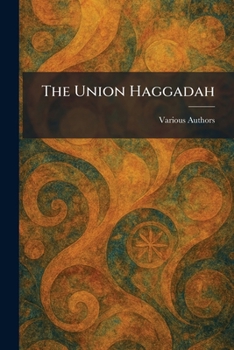
The Union Haggadah

Select Format
Select Condition 
Book Overview
"The Union Haggadah" stands as a foundational liturgical text of the Reform Jewish movement, designed to guide families and communities through the sacred rituals of the Passover Seder. This work provides a comprehensive and accessible framework for recounting the Exodus from Egypt, blending traditional Hebrew prayers and songs with thoughtful English translations and interpretations. By emphasizing the universal themes of liberty, justice, and redemption, "The Union Haggadah" seeks to make the ancient story of liberation resonant for modern observers.
The volume includes the traditional order of the Seder, from the lighting of the festival candles to the concluding hymns, along with musical notations and explanatory notes that enrich the ritual experience. As a historical document of early 20th-century religious life, it reflects a period of significant liturgical development and the desire to balance heritage with contemporary values. This work remains a vital resource for those interested in the history of Jewish worship, the evolution of the Haggadah, and the enduring spiritual significance of the Passover holiday.
This work has been selected by scholars as being culturally important, and is part of the knowledge base of civilization as we know it. This work was reproduced from the original artifact, and remains as true to the original work as possible. Therefore, you may see the original copyright references, library stamps (as most of these works have been housed in our most important libraries around the world), and other notations in the work.
This work is in the public domain in the United States of America, and possibly other nations. Within the United States, you may freely copy and distribute this work, as no entity (individual or corporate) has a copyright on the body of the work.
As a reproduction of a historical artifact, this work may contain missing or blurred pages, poor pictures, errant marks, etc. Scholars believe, and we concur, that this work is important enough to be preserved, reproduced, and made generally available to the public. We appreciate your support of the preservation process, and thank you for being an important part of keeping this knowledge alive and relevant.
Customer Reviews
ThriftBooks ® and the ThriftBooks ® logo are registered trademarks of Thrift Books Global, LLC
