


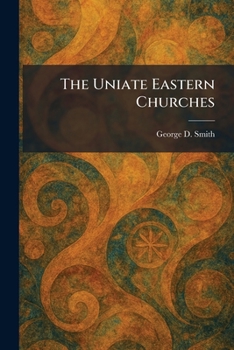
The Uniate Eastern Churches

"The Uniate Eastern Churches" provides a comprehensive exploration of the Eastern Catholic Churches-those bodies that maintain Eastern liturgical and canonical traditions while remaining in full communion with the See of Rome. Written by George D. Smith, this work serves as an essential guide to understanding the complex historical and theological landscape of the Christian East. It delves into the origins, rites, and specific identities of various groups such as the Melkites, Maronites, Ruthenians, and others who bridge the gap between Western Catholicism and Eastern Orthodoxy.
The text meticulously examines the legal and ecclesiastical status of these churches, highlighting their unique position within the broader Catholic fold. Smith discusses the preservation of ancient liturgies and the distinct spirituality that characterizes the Uniate tradition. By offering a detailed account of their struggles for recognition and their role in the unity of the Church, the work remains a significant resource for students of church history, theology, and ecumenical studies. "The Uniate Eastern Churches" is a valuable study for anyone seeking to understand the diversity of the Christian heritage and the historical efforts to achieve communion across diverse cultural and ritual boundaries.
This work has been selected by scholars as being culturally important, and is part of the knowledge base of civilization as we know it. This work was reproduced from the original artifact, and remains as true to the original work as possible. Therefore, you may see the original copyright references, library stamps (as most of these works have been housed in our most important libraries around the world), and other notations in the work.
This work is in the public domain in the United States of America, and possibly other nations. Within the United States, you may freely copy and distribute this work, as no entity (individual or corporate) has a copyright on the body of the work.
As a reproduction of a historical artifact, this work may contain missing or blurred pages, poor pictures, errant marks, etc. Scholars believe, and we concur, that this work is important enough to be preserved, reproduced, and made generally available to the public. We appreciate your support of the preservation process, and thank you for being an important part of keeping this knowledge alive and relevant.
Customer Reviews
ThriftBooks ® and the ThriftBooks ® logo are registered trademarks of Thrift Books Global, LLC
