


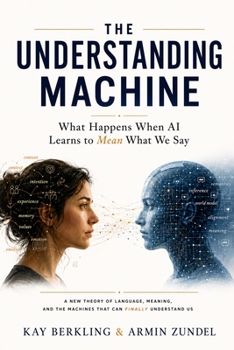
The Understanding Machine: Machinosemiotics
No Customer Reviews

Current theories of meaning - from Saussure through Grice, Gadamer, and speech-act theory - treat communication as compression: a structured situation flattened into words, partially reconstructed by the listener. This book argues that AI-mediated communication constitutes a qualitatively different operation: *transduction*, a structure-preserving mapping between non-identical context-models, in which meaning is carried as relational topology rather than lexical content. Drawing on Peircean semiotics, distributed cognition, and computational pragmatics, the framework introduces a five-dimensional field model (situational content, causal-temporal structure, goals, interpersonal relations, epistemic status) and applies it across twelve case studies spanning aphasia recovery, cross-linguistic mediation, institutional communication, and clinical follow-up. The analysis yields four falsifiable theses - on transduction, substrate-independence, compression-override, and distributed authorship - alongside design principles for transparency, speaker veto, and field-depth symmetry. The book is written for researchers in philosophy of language, HCI, and AI ethics, and for informed practitioners working at the intersection of computational systems and human meaning-making.
Format:Paperback
Language:English
ISBN:3948789037
ISBN13:9783948789039
Release Date:August 2026
Publisher:Inline Internet Online Gmbh
Length:228 Pages
Weight:0.72 lbs.
Dimensions:0.5" x 6.1" x 9.2"
Customer Reviews
0 rating
Copyright © 2026 Thriftbooks.com
Terms of Use | Privacy Policy | Do Not Sell/Share My Personal Information | Cookie Notice | Cookie Preferences | Accessibility Statement
ThriftBooks ® and the ThriftBooks ® logo are registered trademarks of Thrift Books Global, LLC
ThriftBooks ® and the ThriftBooks ® logo are registered trademarks of Thrift Books Global, LLC
