


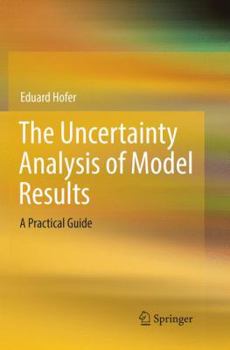
The Uncertainty Analysis of Model Results: A Practical Guide
No Customer Reviews

Select Format
Select Condition 
Book Overview
Introduction and Necessary Distinctions1.1 The application of computer models1.2 Sources of epistemic uncertainty1.3 Verification and validation1.4 Why perform an analysis of epistemic uncertainty1.5 Source of aleatoric uncertainty1.6 Two different interpretations of 'probability'1.7 Separation of uncertainties1.8 References2 Step 1: Search2.1 The scenario description2.2 The conceptual model2.3 The mathematical model2.4 The numerical model2.5 Conclusion3 Step 2: Quantify3.1 Subjective probability3.2 Data versus model uncertainty3.3 Ways to quantify data uncertainty3.3.1 Measurable quantities as uncertain data3.3.2 Functions of measurable quantities
3.3.3 Distributions fitted to measurable quantities3.3.4 Sequences of uncertain input data3.3.5 Special cases3.4.1 Sets of alternative model formulations
3.4.2 Two extreme models3.4.3 Corrections to the result from the preferred model3.4.4 Issues3.4.5 Some final remarks3.4.6 Completeness uncertainty3.5 Ways to quantify state of knowledge dependence3.5.1 How to identify state of knowledge dependence3.5.2 How to express state of knowledge dependence quantitatively3.5.3 Sample expressions of state of knowledge dependence
3.5.4 A multivariate sample3.5.5 Summary of subchapter 3.53.6 State of knowledge elicitation and probabilistic modelling3.6.1 State of knowledge elicitation and probabilistic modelling for data3.6.2 State of knowledge elicitation and probabilistic modelling for model
uncertainties3.6.3 Elicitation for state of knowledge dependence3.7 Survey of expert judgment3.7.1 The structured formal survey of expert judgment3.7.2 The structured formal survey of expert judgment by questionnaire3.8 References4 Step 3: Propagate4.1 Introduction4.2 Random sampling4.3 Monte Carlo simulation4.4 Sampling methods4.4.1 Simple Random Sampling (SRS)4.4.2 Latin Hypercube Sampling (LHS)4.4.3 Importance sampling4.4.4 Subset sampling
5 References
Step 4: Estimate Uncertainty5.1 Uncertainty statements available from uncertainty propagation using simplerandom sampling (SRS)5.1.1 The meaning of confidence and confidence tolerance limits andintervals5.1.2 The mean value of the model result5.1.3 A quantile value of the model result5.1.4 A subjective probability interval for the model result5.1.5 Compliance of the model result with a limit value5.1.6 The sample variability of statistical tolerance limits5.1.7 Comparison of two model results5.1.8 Comparison of more than two model results5.2 Uncertainty statements available from uncertainty propagation using Latin5.2.1 Estimates of mean values of functions of the model result
5.2.2 The mean value of the model result5.2.3 A quantile value5.2.4 A subjective probability interval5.2.5 Compliance with a limit value5.2.6 Comparison of two model results5.2.7 Comparison of more than two model results5.2.8 Estimates from replicated Latin Hypercube samples5.3 Graphical presentation of uncertainty analysis results5.3.1 Graphical presentation of uncertainty analysis results from SRS5.3.2 Graphical presentation of uncertainty analysis results from LHS
5.4 References6 Step 5: Rank Uncertainti
3.3.3 Distributions fitted to measurable quantities3.3.4 Sequences of uncertain input data3.3.5 Special cases3.4.1 Sets of alternative model formulations
3.4.2 Two extreme models3.4.3 Corrections to the result from the preferred model3.4.4 Issues3.4.5 Some final remarks3.4.6 Completeness uncertainty3.5 Ways to quantify state of knowledge dependence3.5.1 How to identify state of knowledge dependence3.5.2 How to express state of knowledge dependence quantitatively3.5.3 Sample expressions of state of knowledge dependence
3.5.4 A multivariate sample3.5.5 Summary of subchapter 3.53.6 State of knowledge elicitation and probabilistic modelling3.6.1 State of knowledge elicitation and probabilistic modelling for data3.6.2 State of knowledge elicitation and probabilistic modelling for model
uncertainties3.6.3 Elicitation for state of knowledge dependence3.7 Survey of expert judgment3.7.1 The structured formal survey of expert judgment3.7.2 The structured formal survey of expert judgment by questionnaire3.8 References4 Step 3: Propagate4.1 Introduction4.2 Random sampling4.3 Monte Carlo simulation4.4 Sampling methods4.4.1 Simple Random Sampling (SRS)4.4.2 Latin Hypercube Sampling (LHS)4.4.3 Importance sampling4.4.4 Subset sampling
5 References
Step 4: Estimate Uncertainty5.1 Uncertainty statements available from uncertainty propagation using simplerandom sampling (SRS)5.1.1 The meaning of confidence and confidence tolerance limits andintervals5.1.2 The mean value of the model result5.1.3 A quantile value of the model result5.1.4 A subjective probability interval for the model result5.1.5 Compliance of the model result with a limit value5.1.6 The sample variability of statistical tolerance limits5.1.7 Comparison of two model results5.1.8 Comparison of more than two model results5.2 Uncertainty statements available from uncertainty propagation using Latin5.2.1 Estimates of mean values of functions of the model result
5.2.2 The mean value of the model result5.2.3 A quantile value5.2.4 A subjective probability interval5.2.5 Compliance with a limit value5.2.6 Comparison of two model results5.2.7 Comparison of more than two model results5.2.8 Estimates from replicated Latin Hypercube samples5.3 Graphical presentation of uncertainty analysis results5.3.1 Graphical presentation of uncertainty analysis results from SRS5.3.2 Graphical presentation of uncertainty analysis results from LHS
5.4 References6 Step 5: Rank Uncertainti
Format:Paperback
Language:English
ISBN:3030094561
ISBN13:9783030094560
Release Date:February 2019
Publisher:Springer
Length:346 Pages
Weight:1.12 lbs.
Dimensions:0.8" x 6.1" x 9.2"
Customer Reviews
0 rating
Copyright © 2026 Thriftbooks.com Terms of Use
| Privacy Policy | Do Not
Sell/Share My Personal Information | Cookie Policy | Cookie Preferences | Accessibility Statement
ThriftBooks® and the ThriftBooks® logo are registered trademarks of Thrift Books Global, LLC
ThriftBooks® and the ThriftBooks® logo are registered trademarks of Thrift Books Global, LLC
