


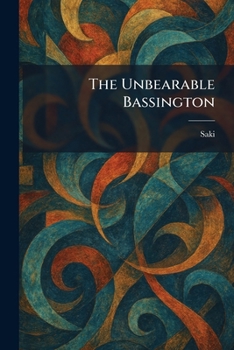
The Unbearable Bassington


Select Format
Select Condition 
Book Overview
"The Unbearable Bassington" is a masterclass in social satire and the debut novel of the celebrated Edwardian wit, Saki (H.H. Munro). Set against the backdrop of early 20th-century London high society, the narrative explores the turbulent relationship between Francesca Bassington and her handsome, yet hopelessly irresponsible son, Comus. Francesca is a woman of taste and ambition whose primary goal is to maintain her social standing and her beloved drawing-room furniture, while Comus is a charming youth whose inability to conform to societal expectations leads to a series of social blunders and his eventual downfall.
Through sharp dialogue and biting irony, Saki dissects the vanity, cruelty, and superficiality of the British upper class. While the author is primarily known for his macabre and witty short stories, this longer work allows for a deeper exploration of character and a more sustained tragic tone. "The Unbearable Bassington" remains a poignant reflection on the consequences of selfishness and the rigid structures of a fading era. It is a work of profound literary merit, balancing devastating humor with a lingering sense of melancholy, making it essential reading for fans of classic British literature and sophisticated social commentary.
This work has been selected by scholars as being culturally important, and is part of the knowledge base of civilization as we know it. This work was reproduced from the original artifact, and remains as true to the original work as possible. Therefore, you may see the original copyright references, library stamps (as most of these works have been housed in our most important libraries around the world), and other notations in the work.
This work is in the public domain in the United States of America, and possibly other nations. Within the United States, you may freely copy and distribute this work, as no entity (individual or corporate) has a copyright on the body of the work.
As a reproduction of a historical artifact, this work may contain missing or blurred pages, poor pictures, errant marks, etc. Scholars believe, and we concur, that this work is important enough to be preserved, reproduced, and made generally available to the public. We appreciate your support of the preservation process, and thank you for being an important part of keeping this knowledge alive and relevant.
Related Subjects
Classics Fiction Literary Literary Criticism & Collections Literature Literature & FictionCustomer Reviews
A good peek at Edwardian England
Little-known masterpiece
ThriftBooks ® and the ThriftBooks ® logo are registered trademarks of Thrift Books Global, LLC
