


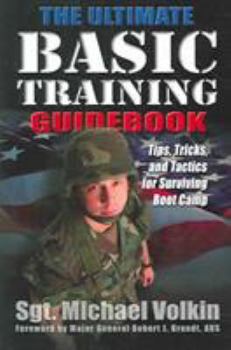
Ultimate Basic Training Guidebook: Tips, Tricks, and Tactics for Surviving Boot Camp

Select Format
Select Condition 
Book Overview
As anyone who has undergone the transition from civilian to soldier will tell you, basic training is a lot tougher and more challenging than any recruit can imagine. Michael Volkin discovered that fact soon after 9-11, when his personal vow to serve my country convinced him to enlist in the U.S. Army. As Volkin quickly discovered, he was utterly unprepared for the new world of the military, "a completely different environment full of unknown exercises and acronyms, where can't eat or talk without permission. Volkin began taking notes on everything and anything with the hope that no one else would have to go through basic training like I did completely unarmed with knowledge that would have eased my transition into the military and allowed me to be more successful. During Operation Enduring/Iraqi Freedom, Volkin organized his notes, interviewed hundreds of other soldiers, and began to write. The result is The Ultimate Basic Training Guidebook, a unique and utterly indispensable guide to successfully coping with and thriving in today's military. The Ultimate Basic Training Guidebook is a comprehensive, practical, and easy-to-follow survival guide written specifically for every new or prospective recruit about to enter any branch of the armed forces. Volkin's book offers step-by-step instructions and solutions, including helpful charts and graphics, for how to prepare both physically and mentally for boot camp. It includes a special eight-week fitness program specifically designed to improve your fitness test scores, specific study guides, an instructional How to"chapter, a list of what to bring (and not to bring) to basic training, tips for success, and much more. The Ultimate Basic Training Guidebook was written by a soldier for men and women who want to become soldiers. No one should enter boot camp without having read this book.
Format:Paperback
Language:English
ISBN:1932714111
ISBN13:9781932714111
Release Date:April 2007
Publisher:Savas Beatie
Length:163 Pages
Weight:1.05 lbs.
Dimensions:0.5" x 6.1" x 8.9"
Customer Reviews
4 ratings
Good Quick Reference
Published by Thriftbooks.com User , 19 years ago
Sgt. Volkin has written an excellent primer for what can truly seem like a mystery: What will I need to succeed in military boot camp? Sgt. Volkin does a great job of laying out the basics, from getting the form right on push-ups and sit-ups, to tips on avoiding too much extra attention from Drill Sergeants. This is a great place to begin for those about to go off to Ft. Jackson or Ft. Benning for the summer. The book does have its limitations. It is written very much for the recent high school grad who is going to basic and then straight into the infantry and Iraq. As someone who doesn't fit that mold (I am tagged for OCS in the National Guard after boot camp), I found some of the material unhelpful. However, that does not in any way limit the usefulness of the book. After all, Volkin has written the book for most people who go into boot camp, e.g. 18 year old recent high school grads. The return on your investment is well worth the small price to pay for this book. I highly recommend it.
Taught an old dog new tricks
Published by Thriftbooks.com User , 19 years ago
People thought I was crazy when, at 31, I decided to enlist in the Army and after trying to run a mile, so did I. I was not in great shape, but this book really helped me out. It is packed full of valuable information, but it is the training program that really makes it something truly special. If you are thinking about enlisting, this is the only book for you.
It's exactly what it claims to be
Published by Thriftbooks.com User , 20 years ago
Having been in the military before, I was sceptical that this book would cover real tips and tricks (I've read many that just only give generalizations and the very basics). While it may be more geared towards the Army/Marine branches, it is valuable to all candidates entering the military. If your going in the military, or know someone who is, this is a must-read! It will give you a practical heads-up and put you ahead of the game. Enjoy.
Dead On about What Happens in Basic/Boot
Published by Thriftbooks.com User , 20 years ago
The man has it dead on about what to expect in basic training, boot camp, or whatever your particular service calls it. His description of how you will be treated by the drill sergeants is completely accurate. His recommendations for getting into shape first is a good idea, it will save you pain later on. Now I've got to put in a few words of my own. ==The basic rules of how you will be treated in basic can be traced down from the training program developed by the Greeks to teach people how to fight in their phalanx. The training works because the raw material, young men, hasn't changed all that much. (Yes, it also works for women.) Yes, the details change -- there wasn't much training in machine guns before the time of Christ -- but the screaming drill sergeants were there then. This book starts with getting to your basic training unit. Before that you will have reported to a reception station. You will probably arrive at the reception station about 3 in the morning, they want you tired, somewhat disoriented, pliable so that you acclimated to the screaming quickly. The stay at the reception station is horrible. You know no one, you have no idea what is happening, where you are going, it's chaos. It's actually semi-organized, just relax as much as you can and go with the flow. The book says you will get lots of sleep and be well fed. I didn't find it so. It was worse than basic. The training in basic, physical, mental, and technical is carefully designed to take in almost any body and convert them to a soldier. It works, almost no one flunks out. Some have a harder time than others in any of the three areas, but 99% of the recruits make it, it's designed that way. If a year or so later you on run into your drill sergeant, chances are he won't remember you. You were only one of the thousands he trained. You can probably buy him a beer and find out that he's really a pretty nice guy. It was all a show.
Copyright © 2026 Thriftbooks.com Terms of Use
| Privacy Policy | Do Not
Sell/Share My Personal Information | Cookie Policy | Cookie Preferences | Accessibility Statement
ThriftBooks® and the ThriftBooks® logo are registered trademarks of Thrift Books Global, LLC
ThriftBooks® and the ThriftBooks® logo are registered trademarks of Thrift Books Global, LLC
