


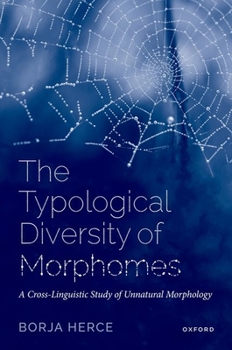
The Typological Diversity of Morphomes: A Cross-Linguistic Study of Unnatural Morphology
No Customer Reviews

This is an open access title available under the terms of a CC BY-NC-ND 4.0 International licence. It is free to read at Oxford Academic and offered as a free PDF download from OUP and selected open access locations. This is the first typologically-oriented book-length treatment of morphomes, systematic morphological identities, usually within inflectional paradigms, that do not map onto syntactic or semantic natural classes. In the first half of the book, Borja Herce outlines the theoretical and empirical challenges associated with the identification and definition of morphomes, and surveys their links with related notions such as syncretism, homophony, segmentation, and economy, among others. He also presents the different ways in which morphomic structures in a language have been observed to emerge, change, and disappear. The second part of the book contains its core contribution: a database of 120 morphomes across 79 languages from a range of families, which are presented and analysed in detail. A range of findings emerge as a result, including the idiosyncratic nature of morphomes in the Romance languages, the existence of cross-linguistically recurrent unnatural patterns, and the preference for more natural structures even among morphomes. The database also allows further explorations of other issues such as the effect of learnability and communicative efficiency on morphological structures, and the lexical and grammatical informativity of morphs and their distribution.
Format:Hardcover
Language:English
ISBN:0192864599
ISBN13:9780192864598
Release Date:June 2023
Publisher:Oxford University Press
Length:318 Pages
Weight:1.50 lbs.
Dimensions:1.5" x 6.5" x 9.1"
Customer Reviews
0 rating
Copyright © 2026 Thriftbooks.com
Terms of Use | Privacy Policy | Do Not Sell/Share My Personal Information | Cookie Policy | Cookie Preferences | Accessibility Statement
ThriftBooks ® and the ThriftBooks ® logo are registered trademarks of Thrift Books Global, LLC
ThriftBooks ® and the ThriftBooks ® logo are registered trademarks of Thrift Books Global, LLC
